
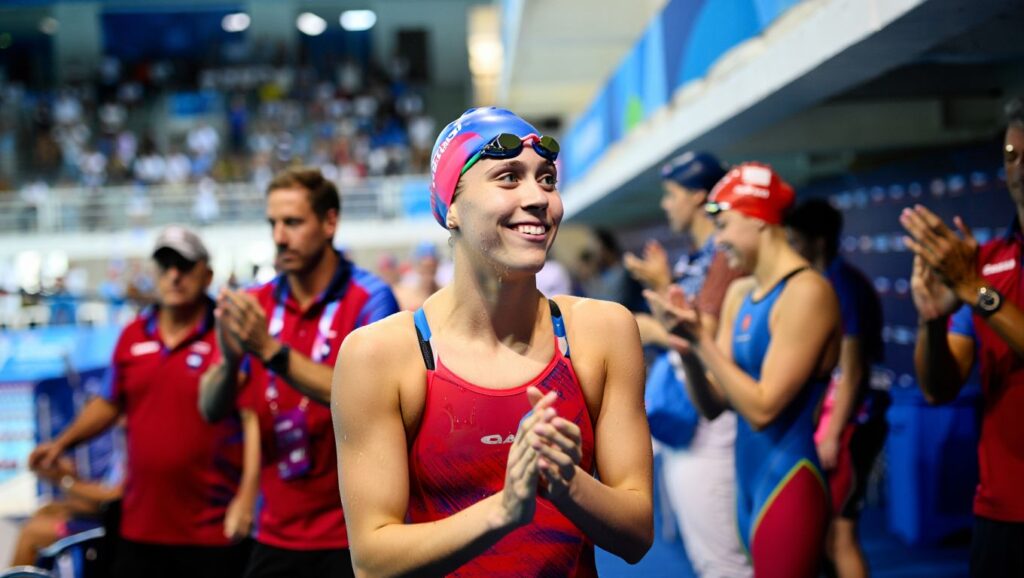
The sun rises on a nation of roughly 27 million, and the lanes start to churn. By nightfall, a tidy stack of medals is won, and a larger world looks on, a bit dazed.
Commentators float theories, fans swear by myths, and numbers offer patterns without a smoking gun. “We can’t reduce this to a single factor,” says the refrain you hear from pool decks to press rooms. Still, the mystery keeps calling—chlorinated, electric, and just out of easy reach.
The paradox that won’t sit still
On paper, a mid-sized population should get outmuscled by the giants. Yet meet after meet, the splits and finishes say otherwise. A steady pipeline of sprinters and milers keeps cresting, as if the ocean itself were coaching their rhythm.
Rivals know it isn’t luck. It’s a shape-shifting advantage that appears simple from afar and complicated up close.
A culture that swims before it walks
In coastal suburbs, kids learn to float before they learn to bike. Primary schools run swim carnivals. Lifesaving is a rite, not a novelty or summer camp.
“Water is our second language,” locals like to say. Beaches, pools, and backyard lap lanes stitch a daily habit into a national mood. When a country treats the pool as public square, champions feel less like exceptions and more like the natural slope of the land.
Systems that look ordinary until they don’t
The machine is mostly local: community clubs, relentless age-group meets, state pathways, and an institute that tests, times, and tweaks. None of this is secret. It’s just unbroken.
Coaches swap knowledge the way surfers swap breaks—openly, sometimes brutally. Technique is a shared currency, and even rival squads compare notes in the name of faster national standards.
What appears as talent is often timing—a teenager meets a coach who can fix a catch, or a program that protects mental health as fiercely as it polishes a race-day start. “We don’t rush the cake to rise,” one veteran coach likes to joke. “We keep the oven just right.”
The hard edge of soft things
You can’t spreadsheet belief. And yet belief drops seconds. The nation’s swimmers don’t just chase records; they chase each other. Training partners become foils, not friends-or-enemies but calibrated pressure.
There’s also the shadow of the rival. Lanes colored by a long transoceanic tug-of-war give every final the feel of a duel. “If you beat them, you beat everyone,” is the quiet mantra.
Pressure is honed, not avoided—sports psych on call, veteran mentors on the deck, journaling beside lactate tests and altitude tents. The science is clear; the feeling is clearer.
Why big budgets don’t buy short laps
Other nations spend more. Others scout broader. But swimming rewards specificity—the thousand micro-skills that blur into two minutes of grace.
In deep programs, the drop-off from first to fourth is tiny. That narrow gap compresses standards and raises the everyday ceiling. If your B-final looks like a world final, your A-final looks like a world record.
Parity inside a small nation can be a multiplier. Iron sharpens iron, and the whetstone is ten thousand boring, perfect repetitions.
The data we can’t fully hold
You can model pool access, coach density, per-capita funding, and age-group participation. You can correlate heatwaves with pool visits and swim meet calendars with exam schedules.
And still, the line won’t go straight. A breakthrough year rises like a tide after a string of stubborn seasons. A relay anchor becomes folklore because four other people believed at the same time. Chance and structure, tangled like lanes in a choppy warm-up.
What imitators might try
Other countries ask for the recipe. Here are the parts everyone can actually borrow:
- Build relentless, local competition—weekly meets, tiny margins, honest timing.
- Treat coaching like a national guild—open clinics, shared video, fewer silos, more apprentices.
- Normalize water as culture—school carnivals, safe access, visible community heroes.
- Protect athlete health—psych support, smart periodization, respect for the human under the cap.
These aren’t tricks. They’re habits. Habits wear grooves; grooves become rivers.
The story the swimmers tell themselves
Ask a champion how it happened, and you’ll hear about a lane that felt too fast to waste, a coach who saw what others missed, a rival who wouldn’t stop coming. You’ll hear about dawn alarms and the hum of a bus at 5 a.m., the day a turn finally clicked into one clean line.
“We’re not special,” some say. “We just keep showing up.” Maybe that’s the trick that isn’t a trick at all.
The world keeps puzzling, running models, counting medals, and waiting for the single, beautiful explanation. Meanwhile, a small country’s swimmers step onto the blocks, eyes forward, shoulders loose, and do something that looks, from a distance, like inevitability. From up close, it is only breath and water and the next, exact stroke.