
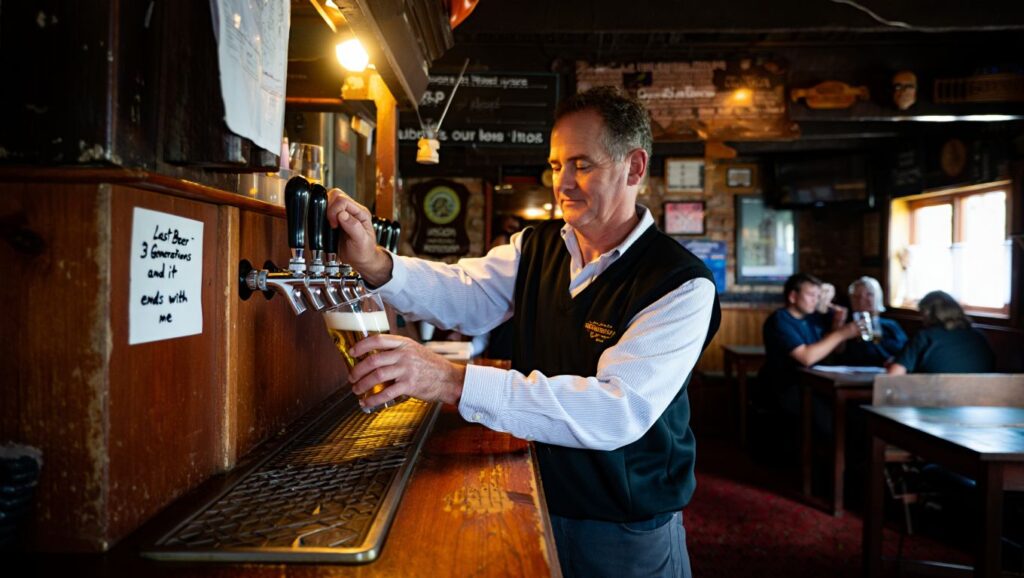
The last schooners slid across the worn timber as a small crowd nursed the evening, and the publican watched the taps run dry.
A bell clinked once, then not again, and a hush settled like dust on a bar that had outlasted fires, floods, and blackouts.
The story is ordinary and enormous all at once: a family place in regional New South Wales, open through harvests and hard years, now closing its doors.
Locals came for one final round, swapping tall tales under the tin roof while the neon beer sign hummed its tired blue.
“This was never just a business,” said Liam, the third-generation licensee, polishing a glass that wouldn’t be filled again.
“It’s been our home.”
A lineage on tap
Liam’s grandparents took over the pub when the main street still smelt of petrol and fresh hay, when the footy bus roared in on winter Saturdays.
They patched the verandah with scavenged iron, learned every first name in town, and tied the pub to the bone of the place.
His mum kept the books on a cigarette-stained ledger, and his dad fixed the cool room with fencing wire and a borrowed socket.
Family photos faded on the wall: a 1974 cricket trophy, a Polaroid of the first karaoke night, a menu that once promised “reef and beef” for $8.
Now Liam stands alone behind the taps and shrugs in that Australian way that means everything and nothing.
“I’m the last in line,” he says, voice steady, eyes on the carvings cut into the bar.
When the sums stopped working
Running a pub used to be about people first, spreadsheets later, but the ledger has sharpened its teeth.
Power bills jumped, insurance ballooned, and excise on each pour kept ratcheting up, twice a year.
“Every time a delivery rolled up, the margin shrank,” Liam said, tapping the keg coupler like a stubborn clock.
“You can’t keep asking a tradie to pay city prices for a beer in a town with six empty shops.”
The slow grind came from everywhere at once, not one big blow.
On a paper napkin, he sketched the pressures that finally tipped the scales:
- Rising energy and insurance costs hitting even on quiet winter weeks
- Excise increases that nibble at every schooner, every single time
- Supply chain bumps that turn reliable deliveries into rolling dice
- Staffing gaps as visas, housing, and burnout thin the roster
- Ageing buildings where each repair finds three new leaks
Changed nights, changed towns
The habits of the town shifted under everyone’s feet.
With random breath testing a constant on the highway, people weighed a pint against the long drive home in the dark.
Footy nights moved to couches and streaming screens, and the appeal of “just one more” lost its easy shine.
A wave of sober-curious culture rolled in, gentle but real, while the cost-of-living squeeze trimmed even weekend treats.
“We still had our diehards,” said Bev, who organised Friday meat raffles for two decades.
“But the young ones spend different, and there’s only so much you can ask from the same twenty regulars.”
Bushfires singed the edges of town one year, floods choked the roads the next.
Tourists detoured, then forgot, and midweek felt like an extended Monday.
The last shout
On the final night, someone wheeled in an old upright piano and found three songs still hiding in its wood.
They passed around photo albums, tore bar coasters into souvenirs, and signed their names on a chalkboard that would soon be wiped clean.
A farmer pinned a faded pennant back onto the beam where it had hung for three generations.
A shearer told a yarn that made the room crack up, then go quiet in a long, comfortable breath.
“This pub was the lounge room of the town,” Bev said, patting the benchtop like it might purr back to life.
“Where you met your crew, sorted a roster, and learned who needed a hand that week.”
What remains, and what might be next
When a pub goes dark, a town loses more than a place to buy a beer.
It loses a bulletin board, a refuge at 5pm, a stage where strangers become mates.
Some locals whisper about a community purchase, a co‑op with rotating managers and a tighter, seasonal model.
Others hope for a “once-a-month” pop‑up with food trucks, music waivers, and a small licence that cuts fixed costs.
The regional council talks grants and façade refreshes, while musicians dream of a circuit that stitches town halls and corner bars into a living map.
A supplier offers to hold prices if the doors reopen for harvest, when utes line the curb and laughter spills across the verandah.
Liam stacks the last crates, turns the key, and rests his hand on the door’s flaking paint.
“Maybe someone younger will give it a crack,” he says, placing the brass float from the first tap into a shoebox of family things.
Outside, the street is still, the moon pooling in the gum-leaf shadows.
For a moment the room seems to breathe, the scent of hops lingering like a stubborn, friendly ghost.