
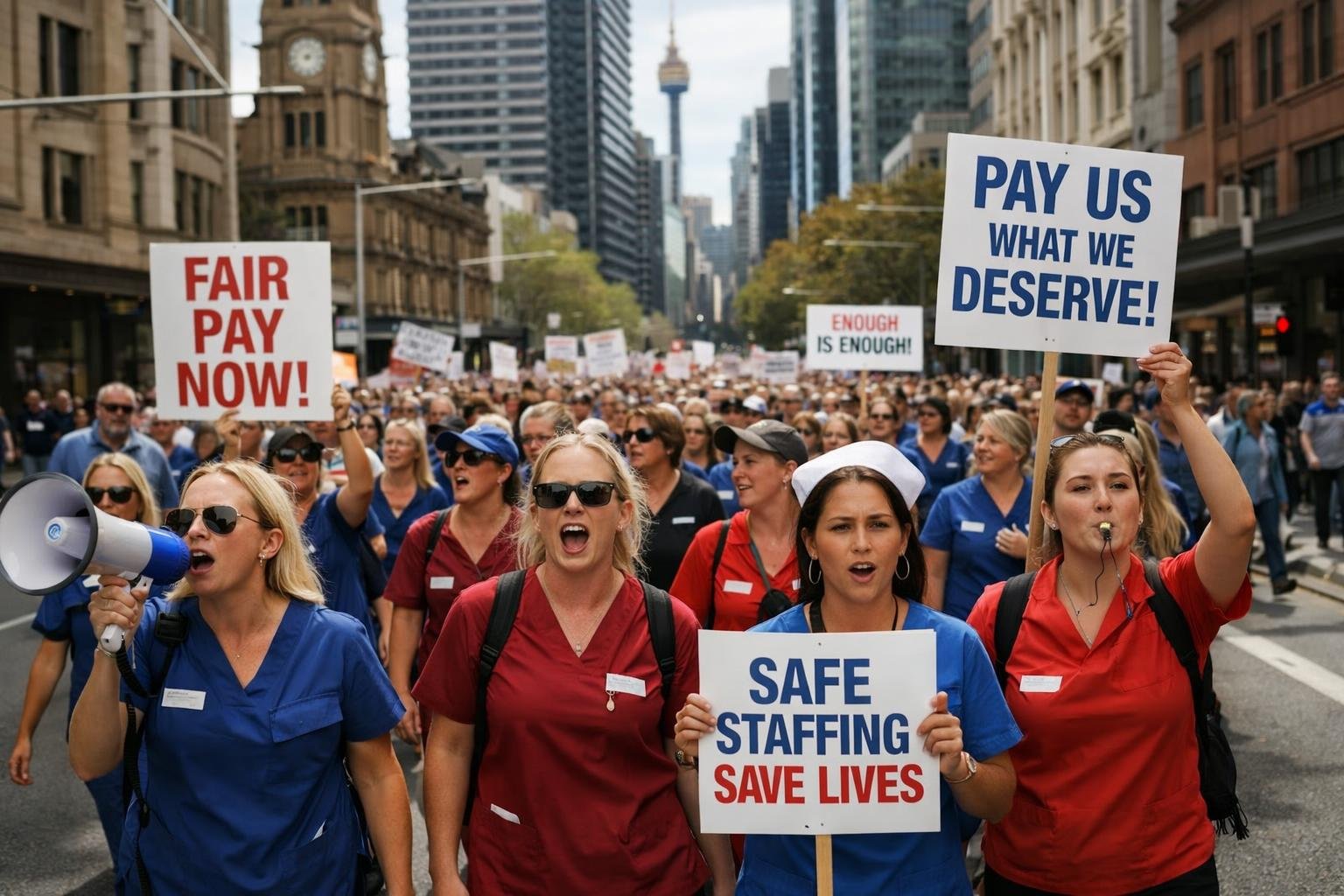
Beneath a winter sky and the city’s high-rises, chants bounced off sandstone facades as several hundred nurses filled Sydney’s CBD with placards, drums, and determination. Commuters paused, office windows opened, and the low hum of weekday routine gave way to a chorus calling for fair pay and safe staffing.
From Hyde Park to the steps of state offices, the line of scrubs moved with steady purpose, each step a reminder that care doesn’t end at the ward door. “We’re not here for a spectacle,” one nurse said, voice hoarse but steady. “We’re here because the system we love is cracking.”
What’s driving the walkout
The catalyst, nurses said, is a stalemate in pay talks that has stretched from urgency to exasperation. Union representatives describe proposals that fail to keep pace with inflation, and workloads that outstrip what safe practice can sustain.
Nurses argue that pay and ratios are inseparable: when staffing levels drop, errors rise, and burnout becomes inevitable. “I don’t want a medal,” said a surgical nurse, “I want a roster where patients can be seen as people.”
Officials have acknowledged “budgetary pressures,” but the frontline response is blunt: cost-of-living surges don’t pause for tight ledgers. Every extra shift, they say, is a quiet compromise with sleep, family, and personal health.
Scenes on the street
The march had the cadence of a profession that plans for contingencies and shows up anyway. Compact prams edged between placards, paramedics waved from passing ambulances, and a brass whistle cut through midday traffic. A few tourists clapped, uncertain at first, then certain enough.
In bright blue scrubs, a midwife held a hand-painted sign: “Safe care needs safe numbers.” She shrugged at a question about the day’s pay. “I’ve already lost more to overtime I shouldn’t be doing,” she said, “than I’ll ever make back.”
The unions and the impasse
Leaders from the state’s main nurses’ union described negotiations as respectful but stuck. “We’ve put forward practical, phased solutions,” a spokesperson said, “but we can’t endorse a deal that bakes in shortages.” They stress that retention is cheaper than recruitment, and safer than permanent overload.
Hospital managers, juggling rosters like complex puzzles, warned that without a credible plan, winter surges could turn corridors into temporary wards. Few on the line wanted to dwell on worst cases, but no one denied they’re already visible.
Government response and next steps
A state health official thanked nurses for their “service,” emphasizing ongoing talks and a need to balance fiscal reality with workforce stability. The language felt familiar and polished, but on the street it landed with mixed reception.
Behind closed doors, both sides are gaming scenarios: phased pay rises, targeted allowances, and time-bound trials for nurse-to-patient ratios. The shape of a compromise exists; the fight is over its weight.
What the workforce says it needs
- A pay rise that outpaces inflation and reflects advanced skills
- Enforceable nurse-to-patient ratios across key wards
- Retention incentives for experienced staff and rural coverage
- Limits on mandatory overtime and safer rostering
- Funded pathways for specialty training and mental health support
Human costs behind the slogans
At the edge of the crowd, an ICU nurse described telling families that their loved one would have to wait. “That’s the part that sticks,” she said, eyes on her shoes. “It’s not the noise of the unit; it’s the silence when I walk away.”
Another nurse, fresh from night shift, tallied the arithmetic of care: the extra hour that becomes two, the lunch break that becomes none, the patient you’re still thinking about at midnight. “We’re not burning out,” she said. “We’re being used up.”
A city pauses to listen
Traffic marshals rerouted buses as a marching drum set tempo against the city’s heartbeat. Office workers leaned over balcony rails, filming; a café worker stepped out with a tray of spare coffees. Small gestures traveled the line, buoying tired faces with quiet thanks.
For a few blocks, daily habit made room for advocacy. The spectacle was peaceful, even polite, as if the city recognized the everyday emergency that rarely spills onto its streets.
Beyond the day’s headlines
What happens next will test political will and the patience of a stretched workforce. Pay packets are the visible metric, but the deeper currency is time—time to assess, to comfort, to catch early decline before it becomes crisis for patient and nurse alike.
By late afternoon the crowd thinned, banners folded, chants faded to scattered applause. The nurses headed back to shifts, to homes, to the uneasy waiting that follows public action. Whether today’s drumbeat becomes policy will determine not just who stays at the bedside, but how safely any of us will be cared for when we most need it.