
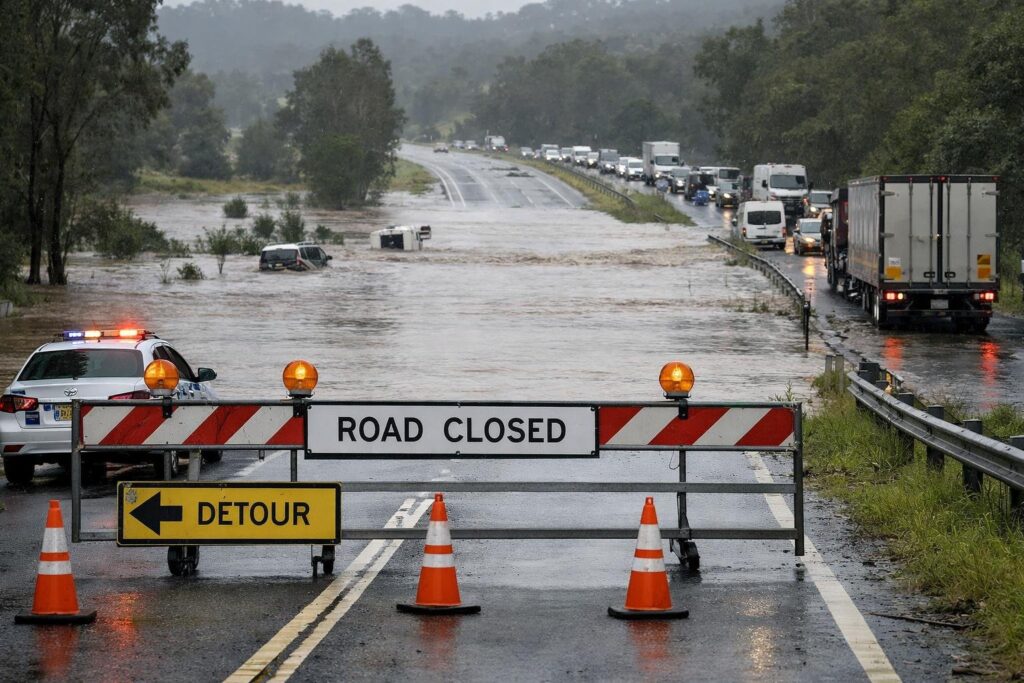
Sheets of rain forced a sudden shutdown of Queensland’s primary north–south artery on Thursday, leaving thousands of drivers stranded and supply chains under strain. With floodwaters cutting a low-lying stretch south of Gympie, authorities warned of lengthy detours and urged non-essential travel to be deferred. “Our priority is safety, and the road will remain closed until water levels fall,” a Transport and Main Roads spokesperson said.
Floodwaters cut a vital link
Swift, rising creeks spilled across multiple lanes, making the surface unstable and visibility poor. Police set up barricades at key approaches while SES volunteers managed traffic and fielded calls from worried residents. “Water can look shallow, then suddenly become fast-moving,” one SES crew leader warned.
The closure underscored how fragile the corridor becomes during deluges, when minor tributaries quickly overtop and funnel into the Mary River catchment. Locals reported “water over the bitumen within minutes,” as storm cells stalled over ridges and valleys.
Hours added to already long trips
With the highway impassable, motorists were pushed toward inland routes that snake through regional towns before rejoining metropolitan arteries. Many northbound and southbound travellers ended up threading toward Brisbane, adding hours to already tight schedules. “What should’ve been a four-hour drive has turned into eight,” said Ella Morrison, who was ferrying work gear to a client.
Freight operators faced an even bigger headache, juggling fatigue limits and refrigerated cargo windows. “You can’t make time you’ve lost to water,” a long-haul driver said at a crowded service stop. He gestured at a line of idling trucks: “Every one of these is money just sitting.”
Forecast keeps communities on edge
The Bureau of Meteorology signalled further showers with possible thunderstorms, which could prolong the closure if catchments remain saturated. While major-river flooding was not universally expected, forecasters cautioned that localised downpours could trigger rapid rises on creeks that cross the transport corridor.
Gympie locals, familiar with the rhythm of wet seasons, still described this week as “uncomfortably swift.” Shops rushed sandbags to doorways, and cafes posted early closures as staff tried to beat the afternoon cells. “We watch the sky, then the gutters, then the creek—always in that order,” said a Mary Street worker.
Detours strain towns and tempers
Alternative highways funneled a sudden surge of cars and heavy rigs, creating bottlenecks on single-lane sections and at country-town roundabouts. Fuel stations ran through their premium stock, and bakery lines snaked onto footpaths as travellers grabbed hot food and phone chargers.
Locals showed a mix of hospitality and fatigue. “We’ll sell you a pie and a map, just don’t block the driveway,” joked a shop owner who had been directing traffic with a rain-soaked hat. Council crews placed portable signs and cleared drain grates, hoping to keep detour routes flowing.
Safety first, even when the clock is ticking
Police renewed the familiar warning: if it’s flooded, forget it. The deceptively calm sheeting over bitumen can hide potholes, floating debris, and missing shoulders. “Turn around rather than become a statistic,” a senior sergeant said, adding that fines and penalties apply for ignoring closures.
Authorities also urged patience at checkpoints, where officers balance public frustration with the cold math of flow rates and bridge loads. “When the water drops to a certain mark and engineers are satisfied, we’ll reopen—never a moment before,” the TMR spokesperson said.
What motorists should know right now
- Check official updates on QLDTraffic and local council channels, allow significant extra time, carry water and basic supplies, plan for rest breaks, and never drive through floodwater—choose signed detours or postpone your trip.
Impacts ripple through supply chains
Supermarkets and fuel distributors reported precautionary reallocations, rerouting deliveries to avoid gaps on essential items. Time-sensitive freight, especially produce and medical supplies, was being prioritized on the clearest windows between downpours. “We’ve built redundancy into routes since earlier flood seasons, but every extra kilometre is extra cost,” one logistics manager noted.
Regional accommodation filled with stranded families, contract tradies, and shift nurses who couldn’t make it through the closure. A motel owner said they were “rolling out extra towels and drying racks,” while trying to keep the Wi‑Fi alive for guests rescheduling flights and meetings.
A community effort, and a waiting game
In roadside carparks, strangers swapped tips on maps and fuel prices, traded snacks, and watched weather radar on dimming phones. A caravan couple offered jumper leads to a young parent whose battery had faded after hours of radio and hazard lights. “People have been kind—that’s what keeps the mood from snapping,” the parent said.
Clearing the highway is ultimately a matter of patience, hydrology, and post-flood inspections. Crews must check for undermined pavement, scattered rocks, and damaged safety barriers before lifting barricades for the eager queue. Each hour without rain brings a little more confidence, and each centimetre the waterline drops brings the coast a step closer to normal.