
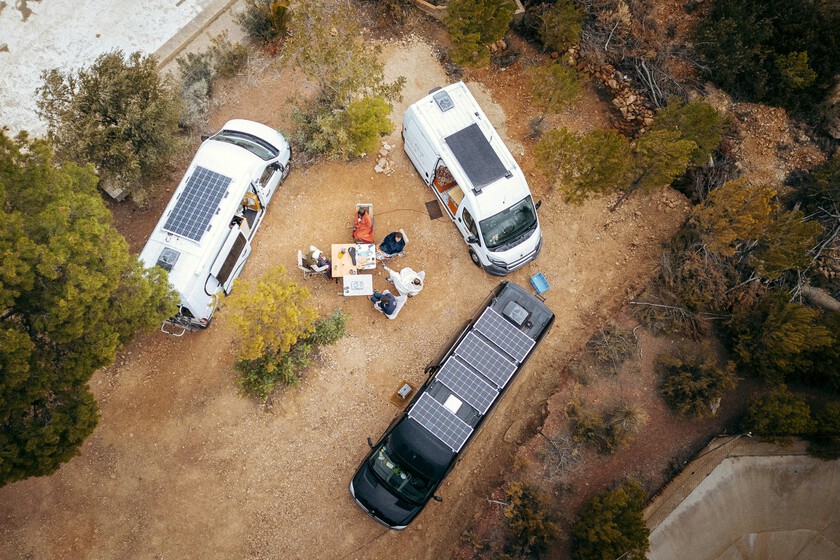
The implementation of PROT 2026/04 instructions from the Dirección General de Tráfico recently changed the rules of the game for campers in Spain. By mandating mandatory ITV inspections for N1 category camper vans older than ten years, administrative pressure on users has multiplied.
That’s why many owners are seeking solutions that allow them to enjoy electric autonomy without adding new modifications to the vehicle, such as “power stations.” These units combine a LiFePO4 battery, an inverter, and a charge regulator into a single device, and those with 2,000 or 3,000 Wh can easily exceed 1,500 euros, with many users considering it more economical than facing the cost and paperwork of a fixed electrical installation.
The key to enormous camper batteries isn’t a legal loophole
Many people think these enormous batteries exploit a regulatory loophole, but the reality is the opposite: the law draws a very clear distinction between a vehicle modification and a device that we simply transport inside it.
Royal Decree 866/2010 and the Vehicle Reform Manual require you to legalise any component that becomes a permanent part of the camper: a fixed auxiliary battery, a bolted inverter, recessed sockets or an integrated wiring loom are reforms and must be homologated.
A portable energy station, on the other hand, is legally considered “a transported load” as long as it operates completely independently, can be manually removed, and is not anchored to the vehicle. The regulation places no cap on its energy capacity: it doesn’t matter whether it has 500 Wh or more than 3,000 Wh, what matters is that it remains a portable, vehicle-independent unit.
That is precisely where one of its great advantages over a fixed electrical installation lies: the latter must comply with the European EMC Regulation R10 and carry the corresponding electrical bulletin (mandatory since late 2022).
Fixed installation or portable battery: two very different ways of understanding a camper
The choice between the two systems depends on how you use the vehicle, because a fixed electrical installation offers much greater integration: it can directly power the water pump, the stationary heating, the lighting, or the vehicle’s outlets with complete ease. In return, it requires professional installation, homologation, and its details recorded on the vehicle’s technical sheet.
The huge portable batteries or “power stations” operate under a completely different philosophy, as they behave almost like a household appliance: they connect directly to devices via their own sockets and can be removed entirely when the van goes back to work, for daily commuting… or if it sits idle for months.
The three red lines you must not cross
That a portable battery (of any size) does not require homologation does not mean it can be installed in any old way. There are three scenarios that cause ITV to stop viewing it as a simple load and start treating it as a modification:
- Screwing it to the floor, to the furniture, or to the chassis: at that moment it ceases to be portable equipment.
- Connecting it to a fixed electrical installation, powering built-in sockets or wiring concealed behind the camper’s panels: in that case the modification must be legalized under Code 8.20 of the Manual of Reforms.
- The third affects charging while driving: charging the battery via the vehicle’s original 12-volt outlet or with portable solar panels poses no problem. However, installing a permanent charger connected directly to the alternator or to the starting battery via new wiring does modify the vehicle’s electrical system and requires homologation.
You also have to transport it correctly, because a “power station” not requiring homologation does not mean it can travel loose about the cabin. These units typically weigh between 20 and 35 kilograms and, in a sudden stop or crash, can become a true projectile.
That is why Article 14 of the General Traffic Regulations requires safe transportation of any load. In this case, the recommended approach is to secure it with certified straps using the vehicle’s original tie-down points, avoiding any permanent mounting. In addition to improving safety, poor stowage can complicate insurance coverage if it exacerbates damage in an accident.
Can portable batteries replace a fixed electrical installation?
Again, it depends on how you use the camper. For weekend getaways or holidays it’s more than enough to run a portable fridge, LED lighting, laptops, smartphones, coffee makers, or even a portable induction hob for short periods. Modern LiFePO4 batteries offer thousands of charge cycles, and many models allow power to be supplied while they recharge.
However, if your camper has a water pump, stationary heating, or a very complete electrical installation that you use frequently, a fixed system remains the more comfortable and efficient solution.
Ultimately, portable batteries or power stations are not a trick to dodge the law nor do they exploit any legal loophole… They are a perfectly valid alternative as long as they are used for what they are: portable, vehicle-independent devices that, for many travelers, are the easiest way to enjoy electric autonomy without facing homologation. Those who need a more complete setup will still find a fixed system the most practical and versatile option.
In Motorpasión | USA is already installing 1 MW chargers for its electric vehicles, but Europe has something better: cars prepared to take advantage of them