
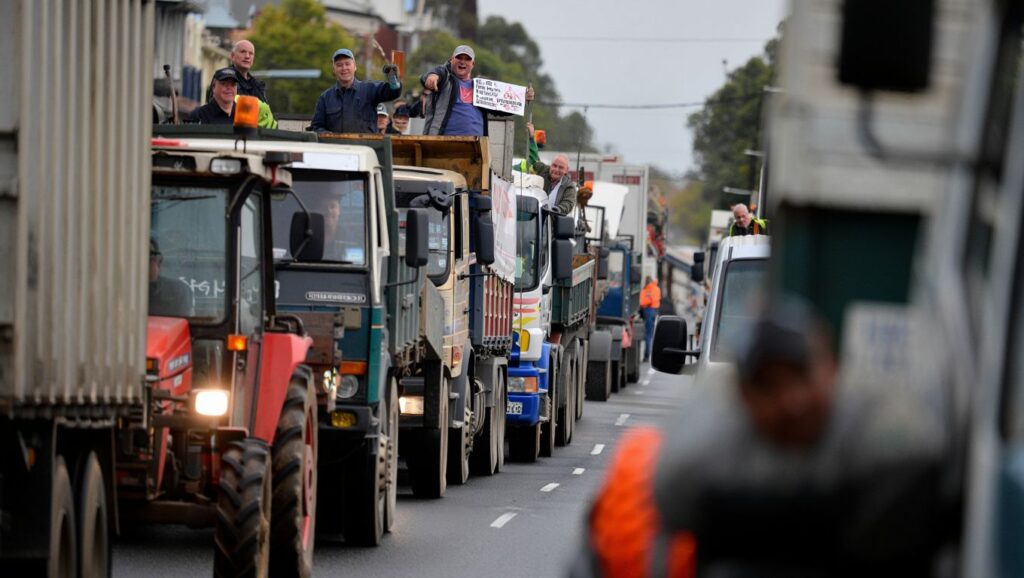
Engines rumbled before dawn as a line of tractors and utes crept along the highway toward the nation’s parliament. The banners were homemade, the horns were insistent, and the message was simple: regional communities feel ignored by decision‑makers who rarely set foot on paddocks. From the outskirts to the inner avenues of Canberra, the convoy’s presence was impossible to miss.
By mid‑morning, the crowd had swelled, a mosaic of akubras, high‑vis vests, and sun‑browned faces. Among them were graziers, grain growers, contractors, and families who had driven through the night. “We cannot farm in a straitjacket,” one producer said through a megaphone, as a ring of bales marked a makeshift stage. Nearby, handmade placards pleaded for “common‑sense” and respect for those who work the land.
Convoy on the Capital’s doorstep
Police managed a careful escort as the vehicles rolled into Civic, their signs flapping in the wind. Drivers kept speeds slow, hazards blinking in an unbroken amber line, while supporters waved from verges and overpasses held hand‑painted banners. The mood was determined, more weary than angry, with a frustration that’s been building over years of incremental rules.
Organizers said the turnout was “a warning shot,” not a blockade, emphasizing they were there to talk, not to choke the city’s arteries. “We’re not here to pick a fight,” said a convoy marshal. “We’re here to be heard.”
The rules that lit the fuse
At the center of the standoff are new land‑clearing regulations that tighten controls on native vegetation and restrict what can be removed without explicit permits. The changes expand offsets, widen habitat buffers, and put stronger onus on proof for “no reasonable alternative,” according to policy summaries circulated ahead of the rollout.
Supporters of the changes say they align with national targets for biodiversity and climate resilience, and bring consistency across jurisdictions. Critics argue the rules are complex, slow to navigate, and costly to comply with—especially for small and mid‑sized operations trying to manage risk in a volatile season.
Why farmers say they’re hurting
Producers describe a daily tension between nurturing country and keeping businesses viable. Firebreaks need to be cleared, invasive weeds controlled, and erosion‑prone gullies stabilized—work that often requires moving scrub, thinning regrowth, or widening existing tracks. “It’s not about bulldozers on rampage,” a cattle producer said. “It’s about doing the little jobs before they become big disasters.”
They say delays on permits, uncertainty over maps, and inconsistent interpretations by agencies add months of limbo. Costs stack up in consultant fees, lost grazing, and the risk of penalties if someone misreads a clause. “You spend the money, and by the time you get the green light, the season has turned,” one grain grower noted. “Our windows are tight, and every week counts.”
Many want the rules adjusted, not scrapped, to reflect seasonal realities, fire behaviour, and the different needs of soil types and enterprises. They also want clearer definitions, especially around “mechanical clearing” versus targeted weed removal.
- Farmers are calling for clearer definitions, faster permit timelines, recognition of fire‑risk mitigation works, fair compensation for set‑asides, and a formal seat at the policy table.
Conservation voices push back
Environmental groups say the stakes are too high for weakening protections. Australia’s ecosystems are already under pressure, with habitat loss a leading driver of species decline, and native vegetation crucial for waterways, soil health, and carbon storage. “We respect regional communities,” said one conservation advocate, “but the science is clear: piecemeal clearing adds up to big impacts.”
They argue the new rules finally give teeth to long‑standing promises, and warn that exemptions can quickly become loopholes. “There’s room for sensible streamlining,” the advocate added, “but not at the expense of habitats we can’t get back.”
Politics in the driver’s seat
The convoy’s arrival puts pressure on the government, which must balance regional economies with environmental commitments and urban political expectations. Rural MPs have urged compromise, warning of simmering anger outside the capital’s ring‑road. Ministers say they’ll engage in “constructive dialogue,” noting that climate targets and biodiversity goals remain non‑negotiable pillars.
Behind the scenes, departmental briefings point to pilot schemes—digital mapping tools, standardised templates, and case managers for complex applications—that could reduce friction. The question is how quickly fixes arrive and whether they go far enough to restore trust.
Stories behind the slogans
For many, the fight is personal. A young family held a sign with a photo of a paddock blackened by last summer’s fire. “We need to clear gorse along the fence,” the father said, “but the process is foggy and the season is moving.” Nearby, an older farmer described a creekline he’s fenced and regenerated, proud of the birds returning. “We’re not anti‑environment,” he said. “We live in it.”
Those stories cut through the slogans, revealing a landscape of trade‑offs where the right answer is rarely neat. They also show a reservoir of goodwill—if policy can meet practice with clarity and speed.
What happens next
Organizers say they’ll accept a seat in a formal working group, but warn they’ll return if the process stalls. Departments are expected to release updated guidelines, with simplified checklists and clearer map layers, within weeks. Industry groups are preparing briefings for members, while environmental organizations will push for monitoring benchmarks and transparent data.
As engines idled and the convoy began to disperse, a sense of unease lingered along with the smell of warm diesel. The road back to the regions is long, and the clock is ticking on planting and hazard‑reduction windows. What happens in the next few months—in meeting rooms far from the dust—will decide whether today’s horns become a dialogue, or tomorrow’s gridlock.