
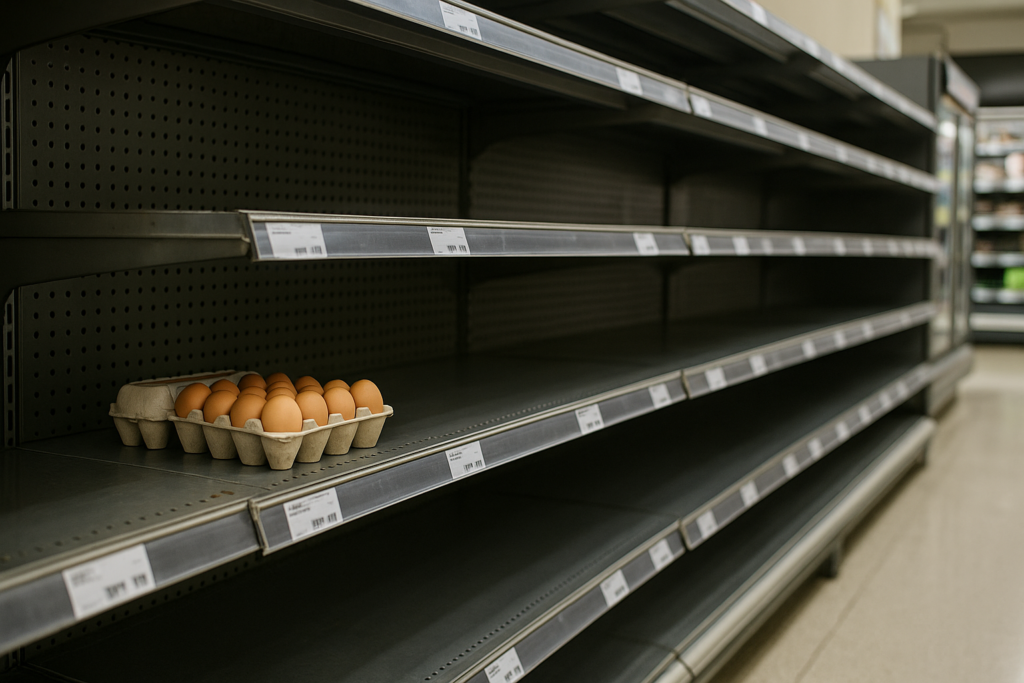
Cartons that once seemed endless are now vanishing, leaving shoppers to scan chilled bays that look oddly bare. Across Australia’s biggest supermarkets, the humble breakfast staple has turned into a scarcity, and the reasons go deeper than a simple spike in demand.
What’s really squeezing supply
Multiple pressures are converging on the same fragile commodity. The most immediate driver is a wave of biosecurity disruptions, with farms tightening movement and culling affected flocks to contain disease risks. That careful response is essential for animal health, but it removes a sudden chunk of national capacity.
In parallel, producers are navigating rising input costs, from grain to transport and energy. When feed gets pricier and diesel climbs, every dozen becomes more expensive to produce, and less flexible to distribute.
The avian-influenza shadow
Recent outbreaks of avian influenza have triggered strict containment protocols, targeted culls, and farm lockdowns. “Biosecurity comes first,” say industry voices, noting that short-term pain prevents longer-term damage. The result is a dip in the laying flock that can’t be replaced overnight, even with aggressive restocking plans.
“Supply is tight, not broken,” is a phrase you’ll hear from people close to the paddock. But when thousands of birds exit the system at once, shelves feel the pinch for weeks, sometimes months.
Why recovery takes time
Eggs travel a long pipeline from pullets to production, grading to packing, and finally retail. Raising a young hen to reliable laying age isn’t a weekend project; it’s a multi‑month cycle with little room for shortcuts. Even if farms place orders today, meaningful volumes arrive only after birds mature, settle, and start laying at consistent rates.
Add in staffing, haulage, and carton availability, and each missing link slows the rebound. When several links strain at once, availability turns patchy, store to store.
Retail limits and shopper behavior
To spread supply more fairly, major chains have used temporary purchase limits in selected regions. It’s a blunt tool, but it helps prevent a few baskets from swallowing scarce stock. Ironically, the sight of low shelves can trigger “just in case” buying, which pulls tomorrow’s cartons into today.
Cafés, bakeries, and meal‑prep businesses add heavy demand on top of household needs, especially during holiday bakes or school‑holiday rushes. Small surges ripple through the system like big waves, leaving dry bays behind lingering peaks.
Price pressures you can see—and can’t
Shoppers notice shelf tickets, but much of the action sits upstream in feed silos and on fuel dockets. Retailers try to balance everyday value with fair returns to keep farms viable. “If farms can’t cover costs, shelves won’t fill,” is a quiet truth the entire chain knows.
Expect occasional substitutions, changing pack sizes, and brands you haven’t seen in your aisle. Flexibility is the stopgap that keeps some cartons moving, however imperfect.
Cage‑free commitments and structural shifts
Australia’s steady shift toward cage‑free and free‑range systems is good for welfare, but it retools capacity. These systems require more space, capital, and careful ramp‑up, so hiccups bite harder. When change meets a disease event, buffers run out faster than the usual playbook expects.
Long term, those commitments should deliver resilient, trusted supply. In the short term, they mean fewer quick levers to pull when shocks hit.
What you can do right now
Until the pipeline normalizes, small adjustments can make a big difference.
- Try different sizes or brands, including barn‑laid or free‑range where available, and consider local markets or farm‑gate sellers for short‑term supply.
- Buy only what you’ll use this week, and avoid doubling up “just in case.”
- Swap eggs in some recipes with flax “eggs,” aquafaba, or powdered alternatives when baking in bulk.
- Seek protein from yoghurt, beans, tofu, or tinned fish to ease breakfast pressure.
- Check earlier in the day, when overnight deliveries are most likely to land.
Signals to watch
Look for retailers to relax purchase limits as distribution catches up with demand. Industry updates on flock rebuilding and disease control will hint at timing for fuller recovery. A steadier run of mixed brands, more sizes, and fewer gaps are the tell‑tale signs that the pipeline is healing.
Until then, expect uneven availability, regional differences, and the occasional empty bay. The fundamentals are intact, but the chain needs a few more cycles to refill, reset, and reliably hit full stride.
The bottom line for shoppers
This isn’t a permanent “egg apocalypse,” but a textbook case of supply‑chain strain meeting biosecurity reality. Farms are protecting flocks, retailers are rationing fairly, and producers are rebuilding capacity. With a little patience—and a few smart swaps—breakfast will look normal again, one carton at a time.