
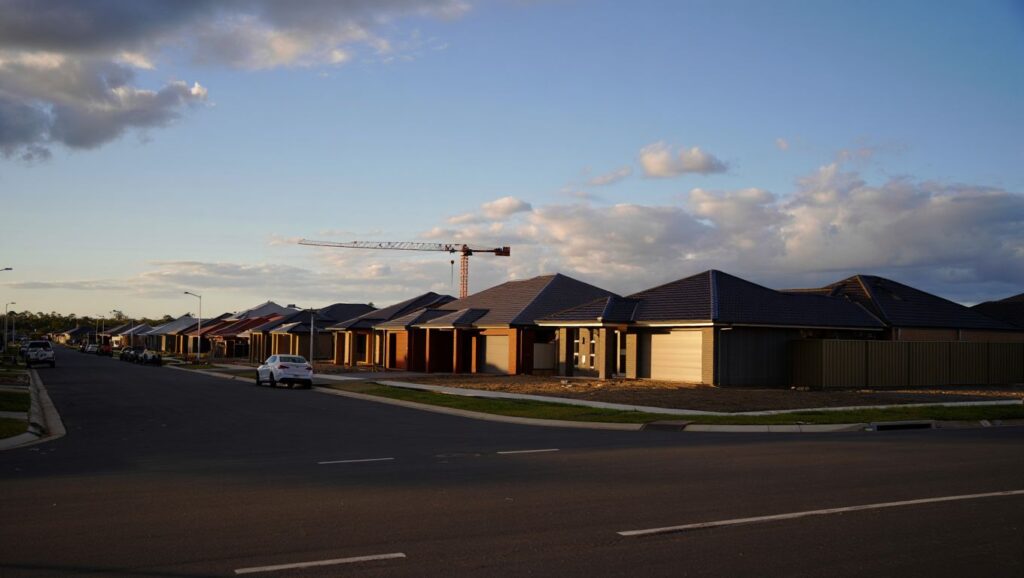
For years, this fringe pocket west of Brisbane was easy to overlook. Today, Ripley is testing what Australian suburbia can become. Master-planned streets curve around new schools, parks, and cafés. Builders hum at dawn; moving vans roll in at dusk. “It felt like we arrived right as the story began,” says Anika, a nurse who moved with her family last spring.
From paddocks to a prototype
Once fields and fencelines, Ripley Valley now reads like a civic workbench. Planners mapped green corridors first, then piped in amenities. Retail anchors landed early, so weekend errands felt possible before every home was standing. “We tried to flip the old sequence—houses first, services later,” notes a regional planner, “because that breeds frustration and sprawl.”
Why families are flocking
Value is the headline, but it’s not the only line. The commute calculus has shifted. Hybrid work turns a 3-day office week into a tolerable trade‑off. Schools, playgrounds, and sports fields lower the daily friction of family life. A steady pipeline of local jobs narrows the distance between driveway and desk.
- New schools and childcare within short drives, plus a growing town centre
- Relative affordability compared with inner-city postcodes, with room to grow
- Extensive parks, dog runs, and bike paths that actually connect to destinations
- Multiple highway links and improving bus corridors toward Ipswich and Brisbane
- A community that’s new enough to be welcoming, yet busy enough to feel real
Property, without the panic
House-and-land packages still undercut many inner-city units, even after a hot cycle. Townhomes offer smaller footprints with lower maintenance, while detached homes keep the backyard myth alive. Investors circle because vacancy rates trend tight, but demand here isn’t only speculative. “We left renting behind and still shaved hundreds off our monthly budget,” says Mark, a logistics supervisor who bought near the new sports precinct.
The infrastructure catch-up—accelerated
Anyone who’s studied outer-ring growth knows the risk: people arrive fast, services arrive slow. Ripley is trying to compress that gap, with staged upgrades hitting in visible waves. New bus links tie into Ipswich hubs; park‑and‑ride lots ease the weekday crunch. The Centenary Highway and Ipswich Motorway shoulder more flow, while rail is the elephant in the room. Official corridors are safeguarded; local chatter says “tracks are coming,” but dates remain a cautious dance.
A day-in-the-life snapshot
Morning brings prams to the shaded loop, cyclists threading past pocket wetlands. By noon, the town centre hums with haircuts, parcel pickups, and stroller‑friendly lunches. After school, ovals fill, and food trucks set up beside twinkling fairy‑lights. “It’s suburban, yes, but it doesn’t feel sleepy,” says Priya, who runs a small bakery. “Fridays we sell out by six, and I still meet three new faces a night.”
Growing pains, in plain sight
Construction dust coats mailboxes and memories; GPS maps lag a street or two. Peak‑hour choke points remind everyone the city is still catching up. Trees have been felled, prompting calls for bolder urban canopy laws. Heat and stormwater are real constraints, nudging builders toward smarter materials. “Rapid growth is a blunt tool,” a local ecologist warns, “unless design stays humble and green.”
What the shift signals
Ripley’s rise isn’t an accident; it mirrors a national pivot. As inner markets price out first‑home buyers, outer belts frame a new social bargain. If the heart of the city sells proximity, the edge now sells possibility. The winning formula blends density, parks, clinics, cafes, and reliable transport within a 20‑minute horizon of everyday needs. Done poorly, it’s car‑bound sprawl; done well, it’s a resilient middle ground.
What comes next
Expect more medium‑rise near the town centre, with shopfronts at street level and apartments above the awnings. Expect schools to double‑shift before new campuses open their gates. Expect politics to chase new voters with busways, rail funding, and pothole promises. Most of all, expect the postcode to shed its “new estate” label and grow a civic voice. “We didn’t move to the edge to be on the margins,” says Anika, “we moved here to build what comes next.”
As the cranes recede and the canopy returns, Ripley’s bet will be easy to read. If the parks stay lively and the main street stays local, growth will feel like a shared win. In a nation obsessed with housing debate, this once‑quiet valley is writing its own answer—one cul‑de‑sac, café, and school bell at a time.