
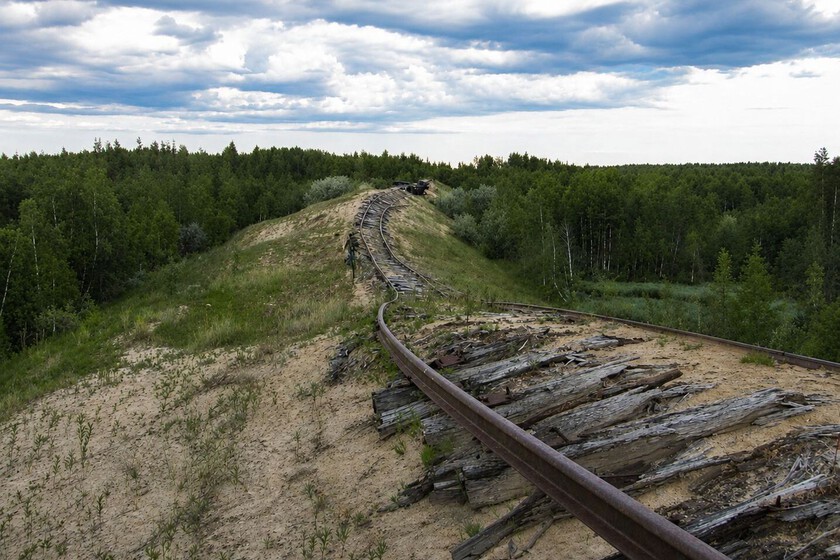
Abandoned locomotives, ghost camps, and miles of railroad tracks emerge anew from the mud and the tundra to remind us of one of the Soviet era’s most ambitious and deadly infrastructure projects: a venture built by tens of thousands of prisoners that claimed thousands of lives before being swallowed by the ice.
Among all those discoveries, the Salekhard–Igarka railway stands out, also known as the Transpolar Line or, more tellingly, the “Death Railway.” Conceived as a colossal transport artery to link Siberia’s interior with Arctic Ocean ports, it ended up becoming one of Stalin’s era’s greatest failures. Today, more than seventy years later, it re-emerges from the earth thanks to the very environment that helped condemn it.
The Railway Stalin Wanted to Conquer the Arctic With
Construction of this infrastructure began in 1947 and was meant to connect the towns of Salekhard and Igarka across nearly 1,300 km of inhospitable terrain, much of it within the Arctic Circle. Its aim was to strengthen Soviet presence in the north, facilitate the exploitation of minerals such as nickel from Norilsk, and create a strategic link with Arctic sea routes.
To raise such a project, they turned to the labor of Gulag camps 501 and 503: estimates place the participation of between 80,000 and 120,000 political prisoners, common criminals, and prisoners of war. The conditions were brutal, with winter temperatures plunging below minus 50 degrees Celsius, food shortages, grueling working days, and logistics that were nearly impossible. Thousands died during construction, which is why the line would come to be known as the “Death Railway.”
These problems were compounded by technical challenges, as much of the route traversed swampy ground perched on permafrost. During the warmer months, the surface layer of the soil liquefied into a mud that warped embankments, displaced rails, and hampered progress.
Thus, Soviet engineers faced an environment that seemed determined to sabotage every kilometer built: the difficulty was such that not even the grand bridges planned over the Ob and Yenisei rivers were completed. For parts of the year, supplies crossed by ferries, and when winter arrived, ice itself became an improvised aid to the transportation system.
But the situation changed radically after Stalin’s death in March 1953, when authorities reassessed costs and feasibility and decided to terminate the project, since after six years of work only about 698 kilometers had been completed. Dozens of camps were abandoned, along with thousands of tons of railway material.
Paradoxically, a portion of the infrastructure endured for decades beyond the project itself: the telephone network installed to coordinate the works kept operating until 1976, long after the railroad dream had been buried beneath the snow and mud of the tundra.
The balance was as bleak as it was spectacular. Roughly 60,000 tons of metal and at least eleven steam locomotives were abandoned in the middle of the tundra. Today, rails, bridges, barracks, and old machines can still be found scattered across hundreds of kilometers, making it one of the largest and most unusual industrial archaeology sites on the planet.
In recent years, the progressive thaw of the permafrost is again exposing many of these remnants, drawing the attention of historians, industrial archaeologists, and photographers from around the world. Organizations such as Gulag.cz have long documented the vestiges of the line and the old camps, with images like those in this post.
More than seventy years ago, Stalin attempted to connect the Arctic through a gigantic railway infrastructure designed to transport raw materials and consolidate Soviet presence in the far north, but his project was defeated by the climate, distance, and geography. Today, the same Arctic that condemned it is bringing it back to the surface just as the world again looks to this region as one of the great frontiers of global transport.
In Motorpasion | This crazy Russian invention with an aircraft engine that looks like a James Bond car fulfilled a fundamental mission in the USSR in the 1950s