

Shoppers who love SHEIN, Temu, or AliExpress should brace for new charges in 2026. Europe and France are moving to curb ultra-cheap imports under €150 by adding per-parcel fees. The goal is to make competition fairer while keeping checks simple enough for consumers and carriers. The result will be predictable, flat amounts layered on top of any VAT already due.
What changes in France from January 1, 2026
If Parliament adopts the 2026 budget, France will add a national handling fee to small parcels. The fee would apply to shipments under €150 sent from outside the EU and delivered to consumers. Lawmakers have discussed a band of €2–€5, with the exact amount still pending. Crucially, it would be charged by product category, not by the number of items.
That means one parcel with two identical T-shirts is one category and one fee. But a parcel with a T-shirt and a pair of earrings spans two categories and triggers two fees. The structure is meant to be clear, easy to collect, and hard to game.
From July 1, 2026: an EU customs duty stacks on top
Separately, the EU has agreed to introduce a flat €3 customs duty for small consignments. It targets under-€150 imports that previously escaped duties, especially flows from China. Authorities describe it as a transitional measure ahead of a broader customs overhaul planned later in the decade.
Because the EU duty is separate, it can stack with the French handling fee. So a shopper could see both a national fee and the €3 duty on the same parcel. Officials emphasize the duty is also per product category, not per unit.
“As a reminder,” a finance ministry official said, “this is charged by product category, not per individual item.”
From November 1, 2026: EU handling fee replaces the French one
France’s national handling fee is expected to be temporary, pending an EU-wide approach. From November 1, 2026, a European handling charge between €2–€4 would take over. At that point, French-specific fees would fall away, leaving the EU handling fee plus the €3 customs duty where applicable.
This switch aims to ensure consistency across the single market, reducing patchwork rules for platforms, carriers, and buyers. It should also simplify disclosure, so the total extra cost is easier to predict.
How much extra will you actually pay?
The final number depends on three variables: the date you order, how many product categories you mix, and whether the French budget measure is adopted as planned. VAT rules stay unchanged; import VAT is already collected at checkout by major platforms via IOSS and is separate from these flat fees.
- If you buy two identical items in one category, you pay one set of fees.
- If you buy mixed categories, you pay once per category in that parcel.
- If you split orders into multiple parcels, each parcel can incur its own charges.
- If your parcel value exceeds €150, the scheme differs and standard customs may apply.
Here are simplified scenarios under current plans:
- January–June 2026 in France (if adopted): one category could mean €2–€5 total; two categories €4–€10.
- From July 1, 2026: add the EU €3 duty per category, raising totals to roughly €5–€8 per category until the EU handling fee replaces the French one.
- From November 1, 2026: expect €3 (EU duty) + €2–€4 (EU handling) per category, or roughly €5–€7 each.
For example, one women’s shirt and one men’s shirt count as two categories. That would trigger two sets of charges. Two identical women’s shirts count as one category, so you pay only one set of fees.
Why these measures—and what it means for marketplaces
European policymakers want to address perceived imbalances created by millions of low-value parcels. Domestic retailers argue that ultra-cheap imports enjoy structural advantages that undercut local shops. Platforms like SHEIN, Temu, and AliExpress have surged by leaning on fast logistics and compressed prices.
The new charges are intentionally modest, flat, and transparent, designed to deter abuse without overwhelming consumers. They also shift more attention onto accurate declarations, product safety, and responsible sourcing—areas where enforcement is getting tougher.
For shoppers, the best approach is to stay informed, watch category mixes, and read platform disclosures at checkout. Small adjustments to how you bundle items can change the final cost, and waiting until late 2026 may alter which fees apply.
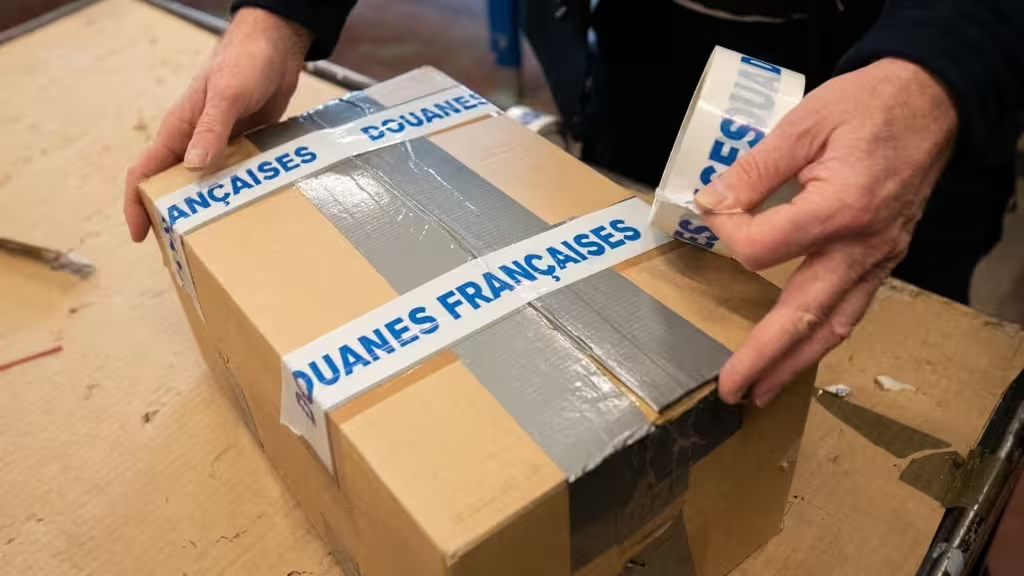
In short, 2026 brings a new baseline for bargain hauls: a small, predictable surcharge per category, first national and then European. The impact on your basket will be real but manageable, especially if you keep your orders simple—and your product categories even simpler.