
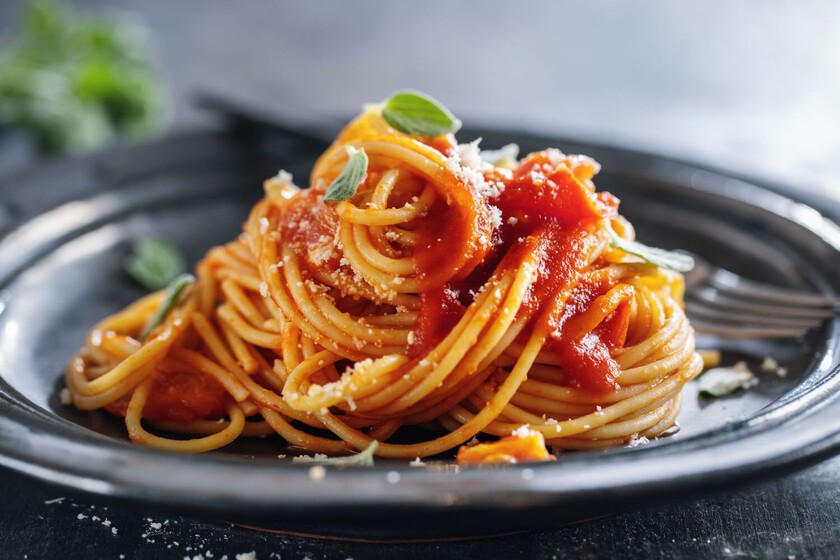
Store-bought pasta sauces are a quick shortcut that lets us cook our own pasta in less time, without fully resorting to a ready-made dish. Yet not all options are equally advisable, neither in quality nor, especially, in nutrition. The Consumers and Users Organization (OCU) has tested the most common supermarket sauces, and the conclusions are clear: tomato-based sauces come out on top.
Three are the main categories of pasta sauces most popular and consumed in our country to pair with any pasta: cream-based, pesto, and tomato-based. Delving into each category reveals dozens and dozens of variants offered by many brands, most in long-shelf formats, requiring no refrigeration until opened, which increases practicality and appeal of these products.
The Consumers and Users Organization has analyzed a total of 236 pasta sauces distributed by the leading supermarket chains in Spain, subjecting them to its so-called Healthy Scale, an algorithm that combines Nutri-Score values with the list of additives and flavorings of a given product. The vast majority of pesto and cream-based sauces fail, while practically all tomato-based ones pass, and many of them with high marks.
It’s worth noting that the OCU has included fried tomato as pasta sauce, a common product in our country, and these tend to score the best.
Excess fats, salt and calories
The major nutritional issue with cream-based and pesto pasta sauces is the excess of two nutrients that can harm health if consumed regularly: saturated fats and salt. Even homemade or artisanal cream- and pesto-based sauces are considerably high in calories and fat, precisely because these are their basic ingredients, with pesto relying on a blend of oils and nuts.
Moreover, commercial sauces frequently rely on low-quality fats; “Cream-based sauces (carbonara, cheese, mushroom) average about 6.75% saturated fats. But pesto-based sauces average around 5.62%,” notes the OCU. Tomato-based sauces, by contrast, average only about 0.79%. As for salt, pesto takes the lead with more than 2% on average; tomato sauces almost always stay below 1%, which is considered acceptable.
The excess fat also translates into a high number of calories, with pesto sauces containing up to five times as many calories as tomato sauces, though the amount of sauce used is typically smaller. “Compared with a maximum of 91 kcal/100 g for tomato sauces (specifically fried tomato), the OCU detects up to 187 kcal/100 g in cream-based sauces (especially those with cheese) and up to 447 kcal/100 g in pesto sauces.”
The organization also notes that cream-based sauces are the ones that most frequently use additives, particularly carbonara-type sauces.
The best and worst pasta sauces
The healthiest pasta sauces
- Hida fried tomato 0% added sugars (89 points, a very good choice)
- Labore fried tomato (89 points, a very good choice)
- Anko artisan tomato sauce (88 points, a very good choice)
- Biocop fried tomato (88 points, a very good choice)
- Consum Eco organic fried tomato (88 points, a very good choice)
- Gallina Blanca homemade fried tomato and onion sauce (88 points, a very good choice)
- Mutti ready sauce with datterini (88 points, a very good choice)
- Auchan Collection (Alcampo) fried tomato with onion (87 points, a very good choice)
- Hacendado (Mercadona) basil sauce (87 points, a very good choice)
- Hida tomato and basil sauce in a homemade style (87 points, a very good choice)
The least healthy pasta sauces
- El Corte Inglés fresh pesto sauce (21 points, a poor choice)
- Mamma Mancini (Aldi) cheese sauce (21 points, a poor choice)
- Auchan (Alcampo) pesto sauce (21 points, a poor choice)
- Eroski Seleqtia pesto alla genovese (22 points, a poor choice)
- Chef Select (Lidl) fresh pesto sauce (22 points, a poor choice)
- La Molisana pesto al basilico (23 points, a poor choice)
- Hacendado (Mercadona) pesto (23 points, a poor choice)
- Barilla pesto alla genovese with Italian basil (23 points, a poor choice)
- Biffi pesto (23 points, a poor choice)
- Cucina nobile (Aldi) pesto alla genovese (23 points, a poor choice)
In DAP | According to the OCU, packaged fish in trays is 45% more expensive than at the fishmonger
In DAP | The best and worst ice cream bonbons according to the OCU: half of them receive a failing grade