
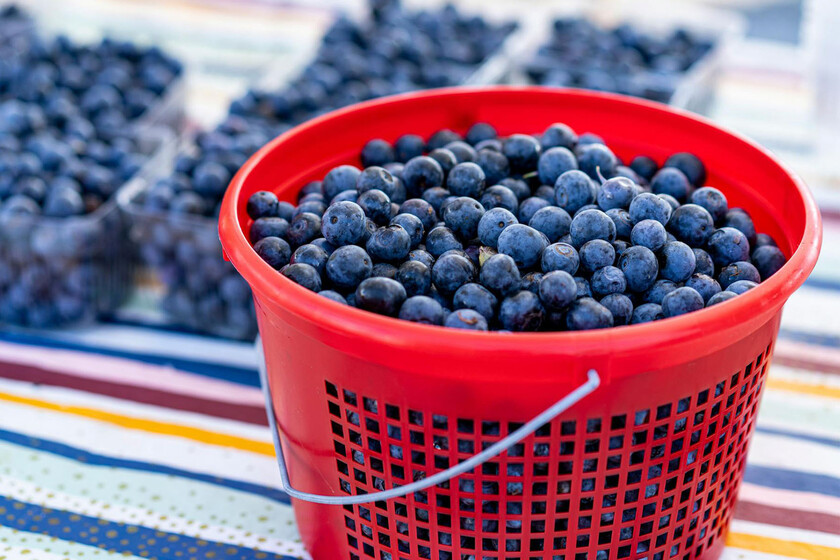
In recent years blueberries have become one of the trendiest fruits. Juicy, lush, highly nutritious, packed with antioxidants and brilliantly blue, they wait on the refrigerated shelves to be enjoyed in many ways, but are we buying the best?
According to food technologist Miguel Ángel Lurueña, one of the most respected voices in the field and author of the blog Gominolas de Petróleo, reality sometimes outpaces fiction and we let ourselves be led, from ignorance, by a false impression.
You’ve almost certainly seen blueberries in the produce section with a kind of white film coating them, and you’ve probably assumed that those berries are past their prime and, far from being at their best, are destined for the trash.
However, the opposite is true, even though we usually associate white color in fruits with decay or mold. So it’s worth taking a look at the advice Lurueña shared on his Instagram account where he explains how and why this white cap appears on blueberries—and on other fruits—and why it’s advisable, if we want to buy better blueberries, to go for those that do have it.
“Many people think they are pesticides, dirt or even mold,” he says. That’s why many people prefer the bluer or shinier ones, that is, those that do not have that whitish layer.
Lurueña considers that this is a mistake, just as “there are also people who wash and rub them vigorously after buying and before storing them in the fridge, to eliminate that rather suspicious layer“. Something that is also an error, he explains, because “it is a wax produced naturally by the fruit itself.”
“What’s special about the bloom is that it forms microscopic crystals that scatter light and produce that characteristic matte effect,” he notes. With that, what happens is that it serves a protective function for the fruit, reducing water loss and helping it stay firm.
In the same vein, it acts as a barrier against ultraviolet radiation from the sun and protects the fruit from fungi, bacteria and other external agents.” Thanks to the bloom, the blueberry lasts better and longer, which is why he noted that “the best are usually those that keep this whitish layer intact” and that “if instead the fruits have a smooth, glossy and bluish appearance, that is not usually a good sign.”
For all these reasons, Lurueña insists that “that whitish layer shouldn’t worry us“, making clear that “on the contrary, it is a good sign.”
In DAP | Blueberry Jam
In DAP | Blueberry Tart