
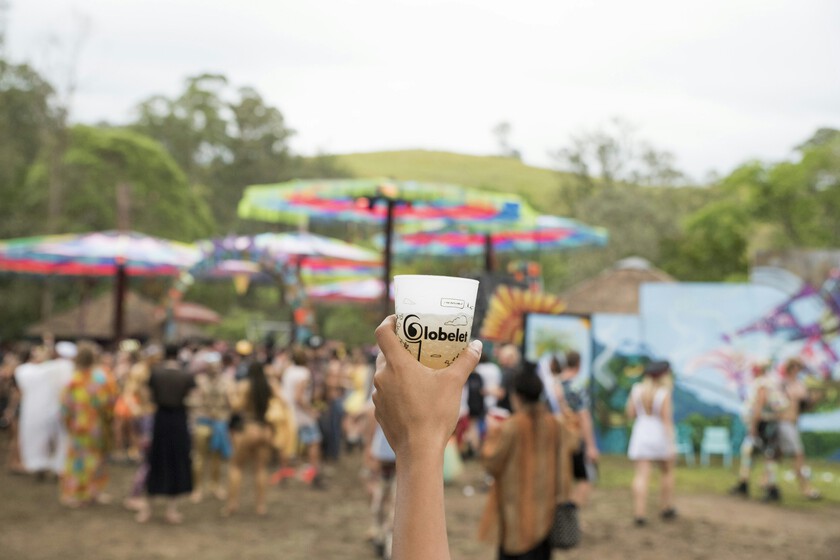
During the marathon stretches of last year’s Coachella, one of the world’s premier music festivals where, paradoxically, music takes a back seat to spectacle, a single image sparked a buzz on social media: the complete absence of lines at the food stalls.
Amid the avalanche of festival-driven content—a social-media showcase where musically only Sobrina Carpenter’s set and Justin Bieber’s revival commanded any real attention—Instagram “get ready with me” posts and the customary parade of themed looks, often ill-suited for the California desert, were added to the mix. Behind the scenes a quiet revolution was taking shape.
Because within this hyper-esthetic ecosystem there was a shadow. In the videos from numerous influencers and tiktokers, we could observe a repeated scene day after day: no queues to get food (even when it’s free), vs packed lines to buy sunglasses or other accessories. For many, the reason was obvious: Ozempic.
We can read this with irony, or, on the other hand, as a clear, deeper cultural symptom that cannot be ignored. Because if anything seems obvious, it’s that at a festival where consuming aesthetics matters far more than consuming food, the Ozempic era has found its best storefront.
Less Hunger = Less Business
Anyone who has attended a festival, especially in recent times, knows what to expect.
Until recently we went in with our eyes closed and our wallets open, assuming that, beyond the rising price of admission, we would shell out absurd sums for a cold hamburger or a rancid pad thai priced like a Michelin-star dish. We entered the game and nobody was surprised by the exorbitant prices; those 20 euros per plate were part of the festival experience ritual; yet something has begun to shift at Coachella. To grasp the scale of this change: the economic volume of its food industry spans more than 100 stalls.
Ozempic and its derivatives are redefining the cultural codes of the last decade. Starting from the premise that each person should do with their body what they please, it’s true that we were already noticing on red carpets and related events that curves were starting to stop being fashionable; with striking examples because they are led by former champions of the “curvy” movement. Actresses and artists such as Rebel Wilson, Barbie Ferreira, or Meghan Trainor show a shift in their figures advancing from photocall to photocall.
Little by little this seeps into society; and it also leaves an unexpected side effect for some. It’s not only transforming bodies, but also habits, including our relationship with food in mass leisure spaces. That shift in the psychological relationship we have with food and the hunger-suppressing effect eliminates that hedonistic, impulsive character from the equation.
If the desire for food ceases to exist, the key turn occurs. For years festivals operated by a simple rule: the economic margin isn’t so much in the ticket price as in everything that happens inside. In that machinery, food is a crucial piece with inflated prices, fueling impulsive decisions on marathon days that invite consumption. This is where Ozempic has broken the model at Coachella, hitting that impulse head-on.
In this showcase where eating “bothers” people, a hunger-control drug isn’t just useful; it’s perfectly coherent with the environment. And yes, Coachella may not be Cruïlla or Arenal Sound, but on a large scale what’s at stake isn’t only what food trucks can bill. The deeper point is this: in a setting where excess was part of the festival’s allure, a model is emerging that places control—especially over the body and the image—at the center, redefining spaces designed for the opposite.
Ozempic and the End of Hunger
The ripple effect of this medication is so expansive that we’re no longer talking about a health phenomenon, but a cultural one. What began as a diabetes drug, later repurposed as a weight-loss solution, is no longer the beauty secret of celebrities. The pharmacological equivalent of “drink plenty of water and get eight hours of sleep” has spread with universal uptake, and with it not only does it transform bodies and their physical consequences, but also behaviors.
What started as a resource for the elite is now heading toward broader, more affordable distribution. Because this isn’t a diet, but something far more radical: disabling one of the most basic impulses of human behavior on a large scale, and the data are beginning to reflect that shift.
Globally, nearly 46 million people are already using these medications. In the United States, the number of non-diabetic people starting treatment with these drugs has grown by more than 700% in just four years. Today, around 12% of adults use them, with annual growth rates close to 30%. That impact isn’t confined to the body and, when we translate it to the context at hand, it’s directly reflected in consumption; these users spend about 31% less on food and beverages, especially on items tied to whims and impulse (snacks, chocolate, etc.).
In Spain the trend points in the same direction: roughly 6% of households are already consumers of these treatments, representing an annual expenditure of about €5.4 billion on food and beverages. And again, the most relevant thing isn’t how much is spent, but what it’s spent on: hedonic consumption declines while basic and functional products rise.
With these figures it’s natural that the discussion of “weight loss thanks to Ozempic” doesn’t die, but it’s no longer limited to Oprah, Kelly Clarkson, or our own Ibai Llanos. The same claim is sliding into and spreading to much closer environments like the office, the neighbor next door, or our circle of friends. If the 1990s and low-rise jeans taught us anything, it’s that the tyranny of aesthetics and thinness is universal and affects everyone equally.
A Transformation That Goes Beyond the Drug
With all this context, it’s tempting to point to Ozempic as the main culprit behind every consumption habit. But the picture is more complex. Beyond the virality of those videos, is there a real change caused by these drugs, or are we looking at an amplified narrative that oversimplifies a broader phenomenon?
Yes, these medications fit perfectly with what the festival projects, but it’s also true that prices inside these events have been pressuring the market and the consumer for years, which translates into a lower volume and frequency of purchases. Moreover, in festivals—and especially one like Coachella—while in earlier years the sense of food consumption was higher, food itself is not the main priority.
The first contenders may be alcohol or items that help project that particular aesthetic, hence the long lines for sunglasses. Even, going to the most basic and simple, that desert setting where you breathe in sand in bursts and those long days across varying temperatures isn’t the ideal stage to open the appetite.
So, more than the origin of the problem, Ozempic is the accelerator and a sign of a transformation already in motion, because the point isn’t how much we eat at a festival, but the relationship with excess and the body. And when this clashes with a business model built on impulse, the impact is no longer anecdotal and goes beyond a video in our feed; we’re facing a structural problem.
If this eventually translates into a drop in internal consumption within these leisure activities, festivals will have to seek other monetization avenues. We can glimpse a near future where they follow the wedding playbook, where the sacred menu used to be the backbone that organized celebrations for our parents’ generation, and now conversations revolve around the beauty corner, the photobooth, and the glitter bar.
Pursuing profitability in the experiential idea as its own product, putting that Insta-worthy experience at the forefront, potentially driving more viral exposure, or a higher ticket price masked by segmentation (more premium zones, deluxe, gold, platinum… à la Ticketmaster), seems to be the path promoters will take. And more sponsorships, of course.
En Xataka | Ozempic y Wegovy ya tienen sucesor: la retatrutida fulmina todos los récords de pérdida de peso
En Xataka | El gran desafío de Ozempic es el efecto rebote. La ciencia ya tiene dos prometedoras soluciones para evitarlo
En Xataka | Ozempic no solo quita el hambre, está reescribiendo el ticket del súper: adiós a los ultraprocesados y al gasto en snacks
Imagen | Unsplash