
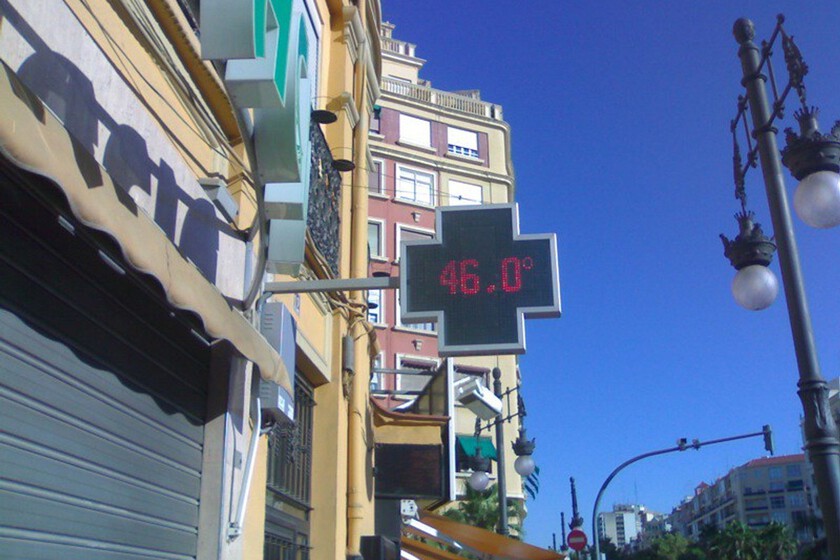
On June 21, the thermometer at Almería airport never dropped below 30.8 ºC throughout the night. In fact, by seven in the morning the temperature was exactly what, twenty years earlier, would have been an August afternoon. It might look like an isolated incident—the first time such a low minimum has appeared in the western Mediterranean in June—but it isn’t.
Barely a few days later, experts at AEMET made their stance clear: there is little point in talking about “tropical nights” in the Mediterranean anymore, because almost every summer night now qualifies. In other words, hardly any nights fall below 20 degrees.
The June heat wave was undeniably exceptional, and not only because the 22nd and 23rd were the hottest days of June in the country since at least 1950; nor because the peninsula-wide anomaly averaged to 7.1 ºC. The most striking anomaly occurred in the early hours: according to AEMET, 24 of its 86 principal stations registered the highest minimum in the historical series.
That was the symptom.
But the problem goes deeper. It relates to a statistic that has begun to mean less just when we need it most: nocturnal heat and its effects on health.
In 2025, a research team from CSIC published a study in Environment International in which they analyzed 178 cities, separating the impact of warm nights from that of warm days. Their conclusions point to a link between nocturnal heat and an increase in mortality of up to about 3 percent, and this effect appears to be independent of daytime heat.
The mechanism is disturbingly simple: if dawn does not cool the body, there is insufficient recovery, sleep quality deteriorates, and cardiovascular or respiratory illnesses can worsen rapidly.
Why should we worry? Because Southern Europe is among the regions most battered by changing temperatures.
There’s more: the same CSIC study found that the excess mortality associated with nocturnal heat in Spain concentrates inland (Granada 3.56%; Madrid 3.45%; Córdoba 3.44%), while the coastal Mediterranean zone holds up much better (Barcelona 0.56%; Alicante 0.55%; Almería 0.46%).
In other words, the problem is one of adaptability to these phenomena. The coast fares comparatively better because it has been dealing with them for years, albeit with lower intensity.
The path into the future. AEMET projects an increase from the current 22 heatwave days per year to 47 by the end of the century under intermediate emissions. Adapting is no longer a choice if we don’t want to end up painting half the country’s windows with chalk or plain white yogurt to keep the interiors tolerable.
Image | Christian Van Der Henst
On Xataka | Beyond gazpacho and salmorejo: Spain’s hidden summer dishes begging to go mainstream