
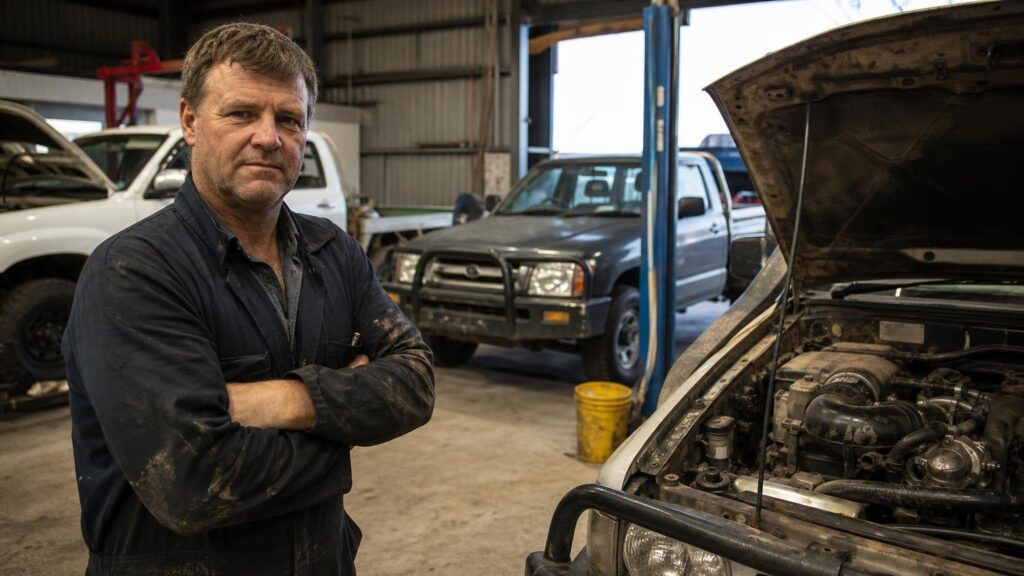
The older I get, the more I trust simple truths: good maintenance beats luck, and some utes are just built with more margin than others. After three decades on the tools, I’ve watched plenty of rigs tap out before the big numbers. But a handful keep showing up, even when the odometer rolls past 400,000 kilometres.
“Oil is cheaper than metal,” I tell customers, and they laugh until the bill gets serious. These are the five I’d put my name behind, the ones I’d buy with high mileage and a clear conscience.
Toyota LandCruiser 70 Series
The old 75/78/79 Series is agriculture on wheels, and I mean that as the highest praise. With the 1HZ straight-six diesel or the 1VD‑FTV V8, there’s meat on every component and room to swing spanners. They survive rough stations, heat, dust, and idling for hours.
Keep cooling systems clean, valve clearances in spec on the diesels, and diffs fed the right oil. When they do break, they break in slow, predictable ways. As one grazier told me, “My Cruiser doesn’t hurry, it just never stops.”
Toyota Hilux (N70/N80)
The Hilux earns its reputation the hard way: worksite to worksite, year after year. The N70 with the 1KD‑FTV and the later 1GD in the N80 are happiest on clean fuel, good filters, and regular oil. DPF systems need respect, not removal; they last if you let them regenerate.
Watch injectors, seats, and timing gear on older engines, and don’t stretch service intervals. The rest of the truck—steering, brakes, body—ages honestly. “It’s not the fastest, just the one that still starts,” a landscaper told me after 480,000 kilometres.
Isuzu D‑Max (4JJ engines)
If reliability had a nickname, it would be 4JJ. This Isuzu diesel will eat distance all day on 15,000 km services and clean air. I’ve seen injectors last like champions, turbos go the distance, and gearboxes keep their temper long after others glaze.
The D‑Max isn’t flashy, but it’s honest, with wiring looms that don’t melt in summer and drivetrains that don’t whine. Keep an eye on EGR soot and coolant, and it rewards you with that quiet, unbothered churn. “It just wants fuel and filters,” said a courier who treats his like a mule.
Ford Ranger PX (3.2 five‑cylinder)
The 3.2 TDCi is a worker, not a show pony. It likes good oil, clean cooling, and gearbox services you can actually remember. When maintained, the engine will happily sit at 2,000 rpm for hours, pulling a loaded trailer without drama.
Electrical gremlins happen, but they’re usually solvable with proper diagnostics, not a parts cannon. Keep an eye on intercooler pipes, mounts, and auto trans fluid life; treat it well, and it’ll keep the torque where you need it—down low.
Nissan Patrol Cab‑Chassis (TD42)
The TD42 is a tractor in ute clothing, and that’s the whole point. Mechanical injection, iron where it counts, and a temperament that forgives abuse. They like clean fuel, steady loads, and coolant that isn’t an afterthought on summer climbs.
Rust can bite old cab‑chassis bodies, and bush use steals bushings, but the heart is stone reliable. “It’s a slow hammer,” a fencer told me, “but it always lands.” Past 400,000 km, the TD42 still idles like a dog waiting for a stick.
What keeps them alive past the big number
It’s not magic; it’s boring discipline. Here’s what I push with every owner who wants their rig to last:
- Change oil and filters on time, not when life gets quiet; use the spec the engine was born for, not the latest fad.
- Keep cooling systems perfect: fresh coolant, clean radiators, tight hoses, and fans that actually pull air.
- Feed them good fuel; cheap, dirty diesel is a fast track to injector and pump bills.
- Service driveline oils—diffs, transfer, gearbox—so bearings don’t chew themselves to glitter.
- Fix little leaks while they’re little; neglect turns a $20 seal into a $2,000 rebuild.
Why these five keep showing up
They share a philosophy: strong parts, sane engineering, and support you can get in farm towns and fringes. Parts are available, workshops know the quirks, and there’s a culture of fixing rather than just replacing. That ecosystem keeps old utes working, even when time says they should have retired.
If you’re shopping used, don’t fear kilometres; fear the wrong owner. A stamped book with clean fluids, straight panels, and a warm start that’s instant tells the real story. As I tell every buyer, “You’re not hunting a bargain, you’re hunting a previous owner’s habits.”
Pick the platform that suits your work, verify the service history, and spend the savings on preventative care. Do that, and one day you’ll look down, see a 4 in front of five more digits, and feel exactly nothing—because your ute just keeps going.