
The two-stroke engine seemed fated to fade away little by little. Between anti-pollution regulations, increasingly complex electronics, and the industry’s obsession with four-strokes, it was taken for granted that it had ended for good.
But Kawasaki has just done something fairly unexpected: officially bringing the two-stroke back into its range of adult motorcycles in mid-2026. And we’re not talking about a retro edition or a nostalgic bike for collectors, but two completely new models developed from scratch.
The two-stroke is back… on its own terms
The new Kawasaki KX327 and KX327X are probably one of the biggest pieces of news in a long time. Essentially because Kawasaki had been out of the big two-stroke segment for years, while KTM, Husqvarna or GasGas dominated that market almost on their own.
And now it has decided to return… but by doing something even more interesting: totally modernizing the classic concept of the two-stroke.
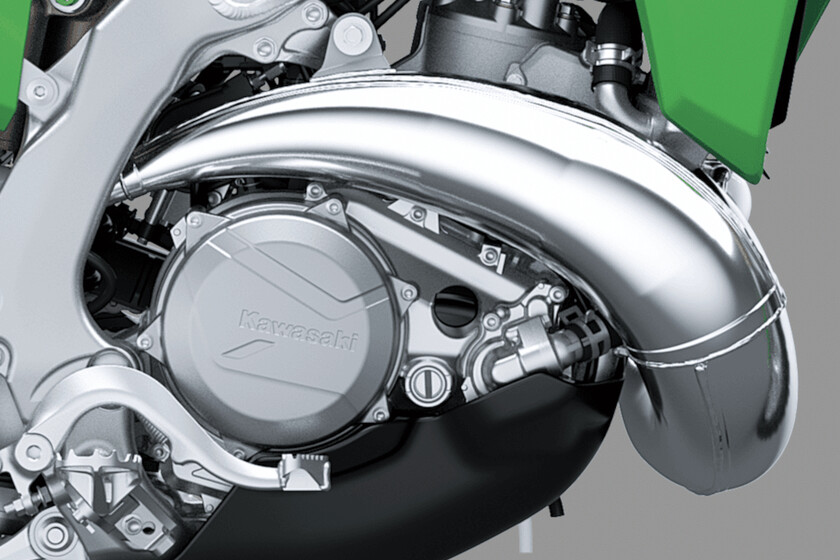
How? That’s the million-dollar question. The great key of these bikes lies in the engine. Kawasaki debuts a new 327 cc single-cylinder, two-stroke with electronic injection, something quite symbolic because for decades the two-stroke was entirely tied to carburetors, jets, and constant manual tuning.
And that’s where probably the biggest change of all appears, because the new KX bikes essentially eliminate one of the historic headaches of the 2T: carburetion. The dual-injection system automatically adjusts operation according to altitude, temperature, or weather conditions, so there’s no need to take half the bike apart to change settings when you climb a mountain or the weather changes.
In other words: Kawasaki wants to keep the good things about the two-stroke (lightness, instant response, wild character and mechanical simplicity) while eliminating much of its classic drawbacks.
And that could be a huge game changer, because many people remain obsessed with the sensations of a two-stroke: how it climbs revs, how it reacts when you crack the throttle, or that aggressive and light feel that virtually no modern four-stroke can replicate to the same extent.
Both bikes share the same base with an aluminum perimeter frame, high-end KYB suspension and Nissin brakes, but then each diverges quite a bit depending on the use.
The KX327X is clearly oriented toward enduro and cross-country, so it features a six-speed gearbox, a short first gear, and a hydraulic clutch to improve feel and control in tricky sections. The KX327 normal, on the other hand, is designed for pure motocross: five gears, a 19-inch rear wheel and a much more aggressive setup for the track.
There are also quite interesting details that clearly show where Kawasaki wants to go: engine maps adjustable from the phone via the Rideology app, a balancing shaft to reduce vibrations, ODI Lock-On grips, and quick-access covers to reach the air filter without spending half the afternoon removing plastics.
In other words: it remains a bike that is quite “mechanical” in spirit… but now fully adapted to the modern era. And that’s precisely what’s so intriguing about all this because just a few years ago it seemed impossible that a major Japanese brand would again throw its weight behind the two-stroke. The market seemed to push only toward more complex, more electronic, and far more filtered motorcycles.
However, off-road has proven just the opposite: there are still plenty of people looking for light, simple, aggressive, and easy-to-maintain bikes, and Kawasaki has just realized that.
The most interesting thing perhaps isn’t even the bikes themselves, but what they represent, because if Kawasaki officially returns to the modern two-stroke, it’s quite likely that other Japanese brands will start to look again toward that segment. Especially now that electronic injection allows far better control of emissions, fuel consumption, and operation.
In Motorpasión Moto | Goodbye to ABS. Europe imposed it and we thought it was unbeatable, but now a brand has just made it obsolete with its century-old invention