
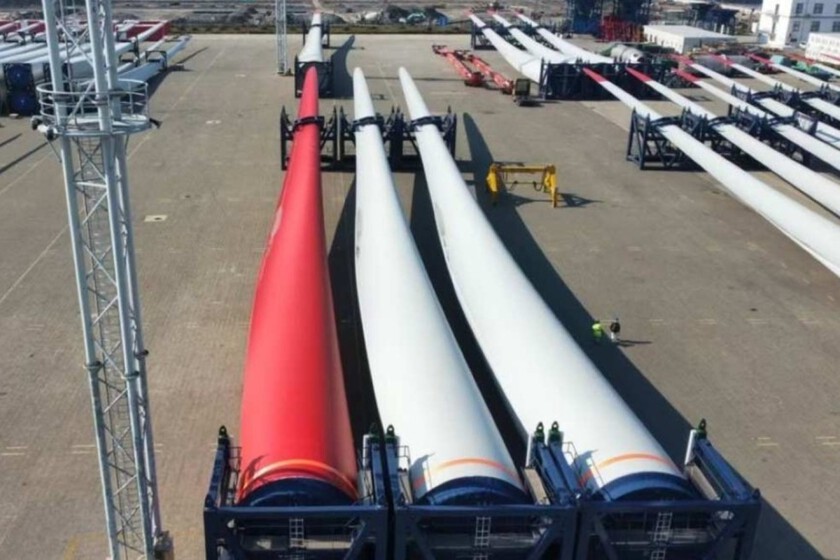
Wind power is one of the fastest-growing renewable sources worldwide, especially in Europe and the North Sea. Yet its development continues to face a major challenge: how to reduce its impact on wildlife. Now, a colossal offshore wind farm wants to test whether a simple measure like painting one blade red can help prevent collisions of birds and bats.
The experiment will take place at Hollandse Kust West VI, an offshore wind farm of 760 MW developed by Ecowende (the alliance formed by Eneco and Shell), which when operational will be able to supply power to more than a million homes per year. There, seven Vestas V236-15.0 MW turbines will feature a single red blade measuring 115.5 meters in length, longer than a football field.
A Red Blade to Help Birds Detect Rotor Movement Earlier
The idea stems from a relatively straightforward scientific hypothesis: when all three blades share the same color, the rotor produces a uniform visual pattern that can be difficult for some birds to interpret, especially in fog, low light, or on strong reflections on the sea. Painting one of them red breaks that symmetry and creates a dynamic contrast that makes the motion easier to detect.
The initiative draws on research carried out in Norway that yielded promising results by partially painting some blades on onshore wind turbines, recording significant reductions in collisions.
Specifically, a study conducted by the Norwegian Institute for Nature Research (NINA) at the Smøla wind park concluded that painting one blade black could markedly reduce bird collisions, with declines of around 70% in some of the monitored turbines. The challenge now is to determine whether the same effect can be reproduced offshore, where migratory routes, fog, and reflections on the water add new variables to the equation.
Engineers ultimately settled on red after evaluating other colors, such as black tones and fluorescent shades, but dismissed them due to potential overheating and durability concerns of composite materials. In contrast, red offered the best balance of visibility, resilience, and thermal performance. According to Lisa Malmquist Ekstrand, vice president of sustainability at Vestas, the aim is to “strengthen the scientific basis that will enable the development of wind farms increasingly compatible with nature.”
Much More Than a Red Blade
This project is part of a much broader strategy, as Hollandse Kust West VI has been conceived as a real-size laboratory to demonstrate that offshore wind energy can integrate more smoothly with ecosystems. Among other measures, it includes taller-than-average turbines designed to reduce interference with migratory routes, and its layout creates ecological corridors between the coast and protected areas such as Brown Bank, included in the Natura 2000 network.
Below the water, four of the foundations incorporate innovative refuges for fish, while the project contemplates reef restoration and the reintroduction of the European flat oyster, a species that disappeared from the Dutch North Sea in the 1950s. Moreover, the piling operations have been carried out using technologies that reduce underwater noise to minimize disturbances to harbour porpoises and other marine mammals that rely on sound for orientation.
This deployment of measures responds to a scenario of massive expansion: the North Sea is solidifying its role as the main engine of offshore wind in Europe, where installed capacity is expected to multiply in the coming decades. Given the scale of this industrial endeavour, the viability and acceptance of future parks will no longer depend solely on energy output, but on their technical ability to coexist with the surrounding environment.
In Motorpasion | The Dark Side of Renewable Wind Energy: Spanish wind turbines kill a million bats a year