
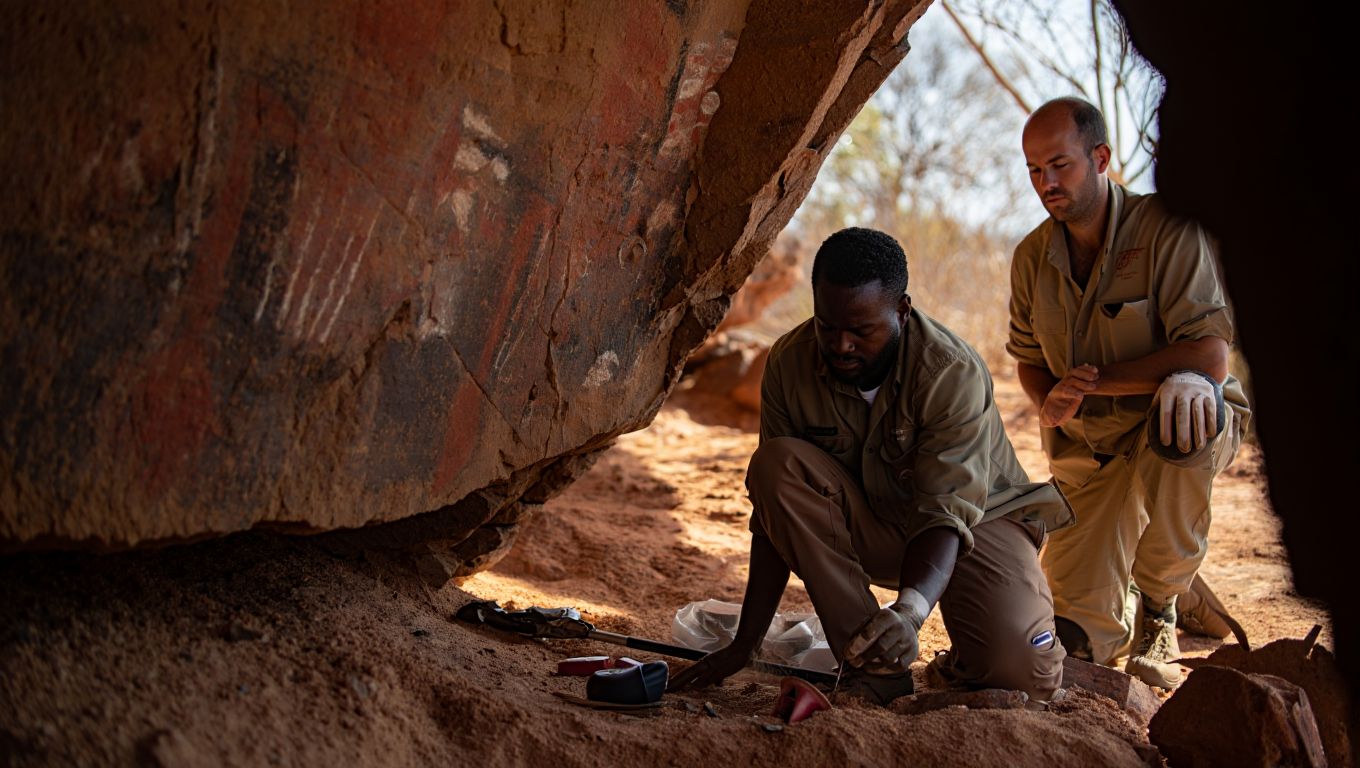
Archaeologists working in Western Australia’s Kimberley region have identified evidence from one of the oldest known Aboriginal rock shelters in the country, adding new weight to the idea that people were living, adapting and developing complex technologies in northern Australia far earlier than once assumed.
The site, known as Widgingarri 1, has produced evidence of human occupation dating back as far as 50,000 years ago. That places it among the most significant archaeological sites in the Kimberley and adds to a growing body of research showing that Aboriginal communities were established across northern Australia deep into the Ice Age.
A shelter that changes the timeline
The discovery matters because it does not simply confirm that people were present. It shows they were using tools, processing materials and living in a landscape that was very different from today.
At the time of the earliest occupation, sea levels were lower and the coastline was more than 100 kilometres away from the site. What is now part of a remote coastal Kimberley landscape would then have been connected to a much broader Ice Age environment.
That detail is crucial. It suggests early Aboriginal groups were not just passing through coastal corridors, but actively occupying and adapting to inland and changing environments.
More than stone tools
Researchers have reported stone artefacts, grinding stones, ground haematite and flakes linked to ground stone axe technology from the deeper layers of the shelter. These finds point to a sophisticated use of resources, not a simple survival camp.
The Kimberley has already been recognised for its extraordinary concentration of rock art, including a kangaroo painting dated to about 17,300 years ago, currently considered Australia’s oldest known in-situ rock painting.
But Widgingarri 1 pushes the story far deeper than the visible art on shelter walls. It speaks to occupation, technology and cultural continuity over tens of thousands of years.
Why it could rewrite prehistory
For decades, the story of Australia’s first peoples was often told through a narrow lens: arrival, survival, gradual spread. Sites like Widgingarri 1 complicate that picture.
They show that Aboriginal people were occupying diverse environments, developing tools and maintaining complex relationships with land much earlier than older models allowed.
The discovery does not rewrite the entire history of Australia in one stroke. But it forces a clearer conclusion: the Kimberley was not a marginal frontier. It was one of the deep centres of human history on the continent.
And every layer of stone, pigment and sediment adds another line to a story that began long before written history.