
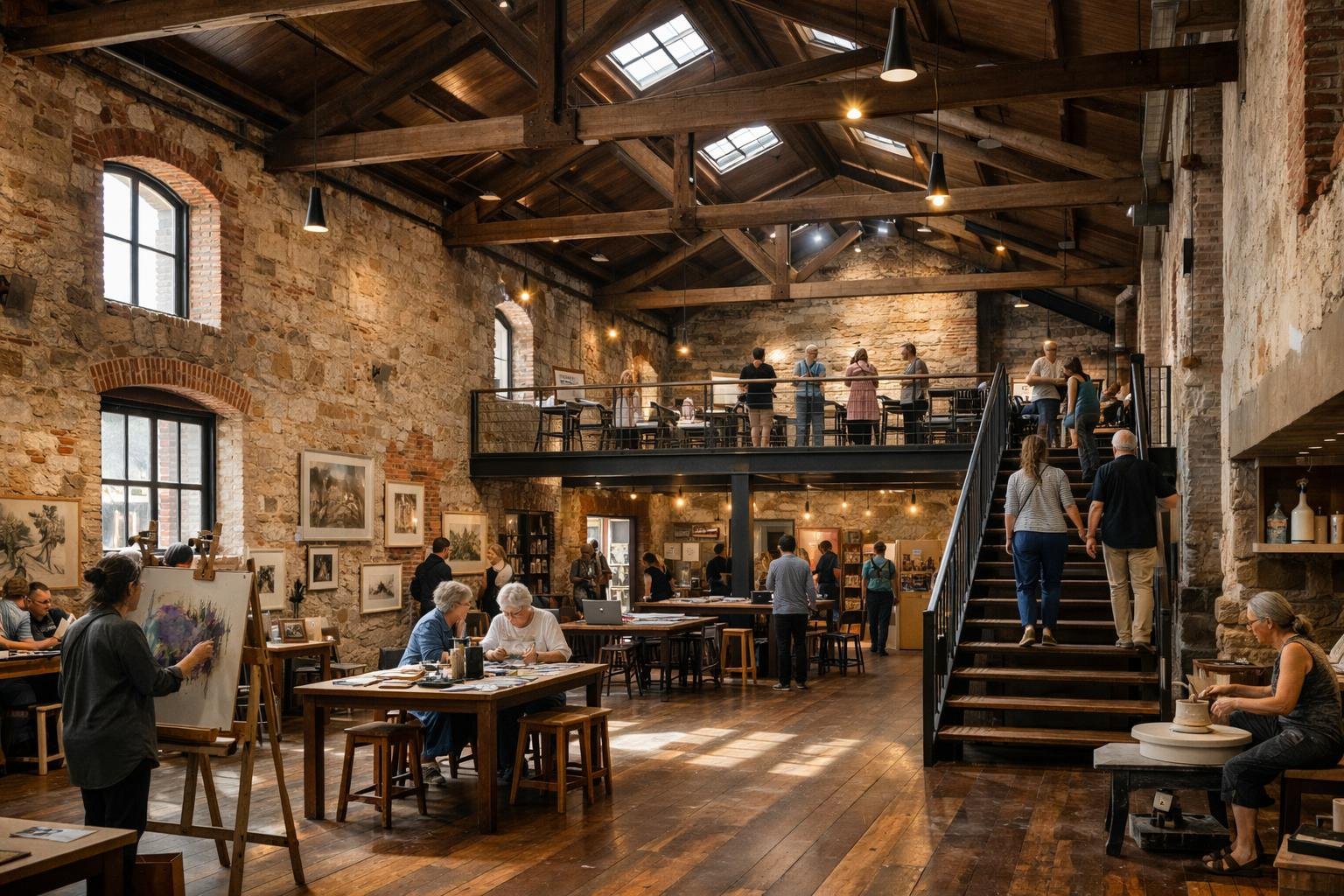
Under a bright Indian Ocean sky, a once-silent warehouse on Fremantle’s west end hums again. After a patient and painstaking restoration, the brick-and-timber landmark has reopened as a community arts hub—part studio village, part performance nest, part classroom—welcoming locals and visitors into a new rhythm of making and meeting.
A portside relic finds its second life
The building began as a workhorse, raised to store cargo and clipper-era supplies. Later it became a shadow, shuttered and drafty, a handsome shell clinging to memory. Now its wide doors roll back to lantern-bright galleries, shared workshops, and a café that smells of espresso and jarrah dust. “We wanted a place where process is as visible as the product,” says inaugural director Lila Tan. “The city gave us a shell; the community brought pulse.”
Layers of history, restored not erased
Inside, the bones show. You can trace salt in the bricks, nicks from ropes, notches where joists met beams. Conservation teams chose to repair, not replace, stabilizing original masonry and stitching in new services with a light touch. “Our mantra was ‘retain the scar,’” notes conservation architect Miguel Duarte. “A city’s texture is memory, and you lose it when you go too clean.”
The result is honest. Floors carry a soft sheen, not a showroom gloss. Steel brackets are visible, almost like jewelry. Signage whispers rather than shouts, letting the space stay generous and curious.
Craft, patience, and a few good scrapes
Restoration took years, with pauses for funding, salt-damp surprises, and the delicate job of threading modern services through old bones. Local trades—stonemasons, joiners, metalworkers—shared the load and the lore. “Every time we lifted a board, the building spoke,” says site foreman Asha Patel. “Sometimes it asked for time; sometimes it wanted a lighter hand.”
Sustainability ran beneath the work like a tide. Reused timbers cut waste, lime-based mortars let the bricks breathe, and a discreet rooftop array now feeds solar back to the grid. Rainwater is harvested for wash-up sinks; ventilation is mostly passive, coaxed by tall windows and the building’s height.
What the hub offers
By day, the place is a maker’s ecosystem; by night, a warm lantern on the street. There are bookable studios, a black-box theatre, a tools library, and a mezzanine where people simply watch. Programming leans broad: ceramics to sound, weave to word, late-night gigs to quiet residencies.
- Studio access for emerging artists, cross-generational workshops, rotating exhibitions, and small-scale performances
“We’re mixing discipline and delight,” says program producer Byron Keane. “A printmaker can meet a choreographer, a coder can bump into a ceramicist. That spark is our currency.”
Opening weekend vibes
On launch day the queue curled like a bilge rope. Kids pressed palms to cool brick, tracing the stamped makers’ marks. A Noongar welcome opened the floor, with elders speaking to Country and the long arc of care. “Places remember footsteps,” said Aunty Marlene. “If we walk together, they remember better.”
Inside, a brass trio echoed off the rafters while a screen-printed map told the site’s tangles—trade, migration, hard work, and the sea’s mood swings. In a corner, volunteers showed how to bind a sketchbook; next door, a dancer explored the room’s gravity, testing what the floor would give.
Looking outward: precinct and partners
The hub is not a solo act. It speaks to a bigger precinct, linking to nearby galleries, the port’s edge, and the warren of laneways where cafés and collectives nest. Partnerships with the university, TAFE, and local schools braid formal learning with messy making. A small fund backs micro-commissions for artists from marginalized communities, with studio time and mentorship folded in.
City support, part grant and part peppercorn lease, came with a nudge toward public value. “The brief was culture with open doors,” says Councillor Ren Gibbs. “We wanted a place that felt owned by the people who use it.”
Access, equity, and long-term stewardship
Nothing stands still at the coast, so governance aims steady. A community board watches the budget, a maintenance plan tracks the salt creep, and rental tiers keep studios reachable. Access routes are wide, signage is bilingual, and a relaxed hour lives on the weekend calendar for people who prefer less noise and light.
Tickets for shows are scaled; many workshops are free with materials covered through small donations and corporate sponsorships. “We’ll measure success by habit,” Tan adds. “If someone drops in twice a week, to fix a hinge or to sketch for ten minutes, we’re doing it right.”
Back on the street, evening folds around the facade. The bricks glow a slow amber, the doors breathe in and out, and music steps into the laneway. A building that stored wheat and wool now stores voices and the sound of ideas beginning. In a port shaped by arrival and departure, this is a place to stay, to test, and to make the next thing possible.