
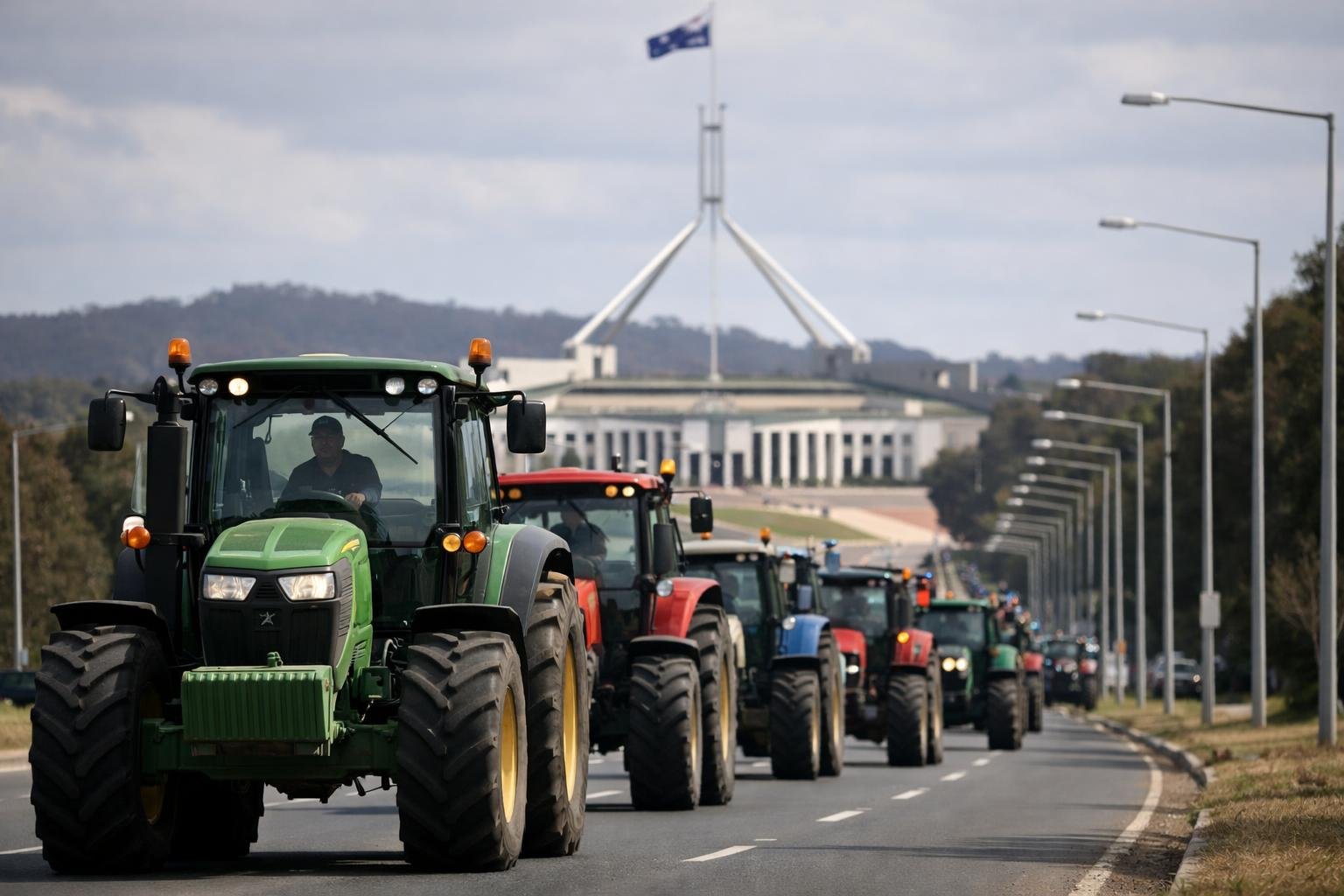
Engines growled before dawn as a river of tractors rolled onto the highway, heading straight for the nation’s capital. What began as roadside chatter in farm kitchens has become a slow, deliberate protest against newly announced water rules that growers say threaten their livelihoods. Parked between diesel tanks and hay, families taped hand-painted signs to cabs, loaded thermoses, and set off with a single message: the system is broken, and rural voices must be heard.
A slow-moving show of force
The convoy stretches for kilometres, a moving argument in metal and mud that draws honks, waves, and phone cameras from overpass crowds. Intersections fill with flags and fluorescent vests, while dogs nap in passenger seats beside laminated maps of catchments and canals. “We planned for seasons,” said one orchardist, leaning from his cab window, “but you can’t plan for rules that flip mid-harvest.”
Police escort vehicles run lights and keep the procession at a steady crawl, while volunteers pace along tandems, checking chains and helping smaller tractors tackle the hills. The effect is theatrical, but the logistics are serious—marshals share radio channels, fuel pickups are prearranged, and rest stops are timed with farmer precision.
What sparked the revolt
At the centre is a package of water reforms: tighter allocations, faster ramp-ups of metering, stricter compliance on extractions, and expanded environmental flows through key river systems. Supporters argue the rules are vital to protect wetlands and species, particularly after years of drought and climate-driven swings in rainfall. Growers say the changes are sudden, poorly sequenced, and indifferent to plantings already in the ground.
“Water is our paycheck, not a spreadsheet line,” said a cotton grower, biting words between radio calls. “If you cut us without notice, you cut the town’s jobs—from the mechanic to the school canteen.”
Life on the margins
Margins on many properties are already thin. Diesel is still expensive, input costs keep climbing, and contracts expect tonnes that only reliable water can grow. One missed season becomes two missed repayments; one failed orchard becomes another vacant block on the highway out of town. “You don’t bank trees like wheat,” said a stone-fruit producer. “Turn the taps off and the trees die, and with them decades of work.”
Rural leaders warn of ripple effects: lower yields push prices up, supermarkets lean on imports, and young workers drift to cities. “We don’t want a handout,” said a dairy farmer near the convoy’s rear. “We want a framework we can trust for more than one season.”
Inside the policy tangle
Officials point to court obligations and international commitments to maintain environmental health in rivers long pushed beyond limits. “We hear the frustration,” a government spokesperson said. “But we must manage scarcity fairly, restore degraded systems, and ensure water is sustainable for generations to come.”
That framing lands like a lecture to some in the bush. Many accept environmental targets, but question whether models reflect reality on the ground—evaporation losses, conveyance constraints, and local innovations already saving water. They want a process that is transparent, adjustments that are phased, and compensation that feels genuine when entitlements are reduced.
What protesters want
Their placards condense complex grievances into practical asks:
- A time-limited pause on the rollout where summer plantings or perennial assets face immediate harm
- An independent review of modelling, with rural experts and on-farm data fully published
- Fair compensation or buyback terms when rights are diminished, not symbolic gestures
- A permanent seat for regional voices in water governance, including seasonal scenario planning
Scenes from the road
At a fuel stop, a grandmother hands out scones from a plastic tub, while teenagers chalk slogans on tractor weights and snap group photos. A shearer, off-season, waves a grease-stained cap and talks about river levels he’s watched his whole life. “You can’t fix a floodplain from an office tower,” he says, drawing nods from a circle of drivers.
A counter-protester holds a neat placard calling for stronger protections and points to fish kills of recent years. For a moment, debate breaks out, then softens into questions over shared ground: nobody wants dead rivers, nobody wants dead towns.
At the gates of power
By mid-afternoon the lead vehicles edge within sight of Parliament, banners lifted and engines idling. Organisers insist on lawful conduct, and the route has been agreed with police who direct tractors into a broad, orderly loop. A petition—thick with signatures from shires across the basin—awaits handover to committee staff.
Speeches are short, tempers are tight, and the air smells of hot diesel and sun-baked rubber. “We’re here because we tried every other door,” a young irrigator says into a portable mic. “Open this one, and we’ll help write rules that actually work on the ground.”
The road beyond today
Whether the day reshapes policy depends on what follows: real talks, transparent data, and timetables that meet biology as well as bureaucracy. The tractors will head home, back to paddocks that won’t wait for press releases, and to animals and trees that demand water on their own clock.
But something changed on the asphalt today—farmers stepped out of their furrows, brought their case to the steps, and asked the country to choose a balance that keeps rivers alive and rural communities standing.