
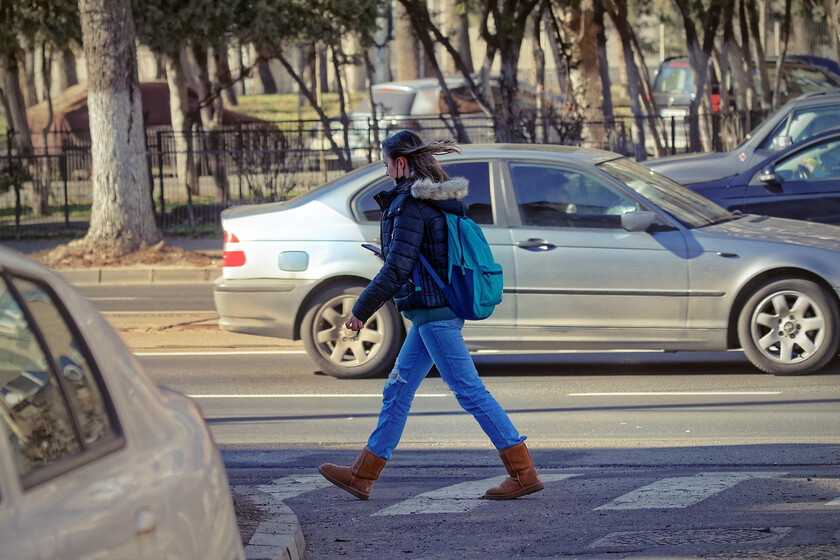
Drivers see it all the time without paying much attention. A pedestrian crosses, raises a hand, nods, or offers a smile before continuing on. The gesture lasts less than a second, and according to several psychologists specializing in prosocial behavior (a repertoire of social and positive actions), it says far more than it appears.
The Brazilian media outlet Minha Vida published an analysis of this everyday reflex, drawing on studies of social interactions. The central conclusion is that thanking the driver who slows down is not merely good manners: it is an indicator of how that person relates to the world around them.
Gratitude as a Habit, Not a Calculation
The first trait researchers point to is empathy. Those who thank the driver have processed, even if unconsciously, that the driver has altered their trajectory and has pressed the brakes.
Even when the driver is in front of a crosswalk, with a duty to yield to pedestrians, acknowledging that minimal effort implies a certain capacity to put oneself in the other person’s shoes—something not everyone does amid urban traffic.
To that is added what psychologists call emotional intelligence, i.e., the ability to read the implicit social codes of a situation and respond to them appropriately. The crosswalk is, in theory, a regulated scenario where pedestrians have priority. The person who says thanks understands that, beyond the rules, there is a person on the other side of the windshield.
Another element that appears in the analysis is the gratitude as a stable personality trait. People who express recognition habitually, even for trivial gestures, tend to foster social relationships with less conflict. Not because they are necessarily more altruistic, but because they value the small exchanges that make coexisting with strangers somewhat easier.
In the urban environment, where pedestrians and drivers frequently compete for the same space, that gesture acts as a small tension solvent. It humanizes a situation that would otherwise be reduced to a mechanical interaction between a mass of flesh and two tons of metal.
Psychologists identify up to six traits that frequently appear in these pedestrians: empathy, emotional intelligence, gratitude, respect for communal norms, spontaneous courtesy, and a tendency toward social cooperation. They do not constitute a fixed profile, nor a diagnosis, but rather statistically more common patterns.
The authors themselves caution that some people express thanks out of cultural inertia or simple mimicry, without reflecting any particular personality trait. Yet the general trend suggests these behaviors align with how each person manages their relationships with others outside the crosswalk.
In cities where moving about has become a constant source of stress, and where a simple courtesy—such as inviting the driver to go ahead, even if it could incur a fine under the DGT—can be the closest thing two strangers have to a genuine human exchange all day.
In Motorpasion | Your car’s oil is going to run short this summer, and it’s no joke: change it now or it could cost you dearly in autumn