
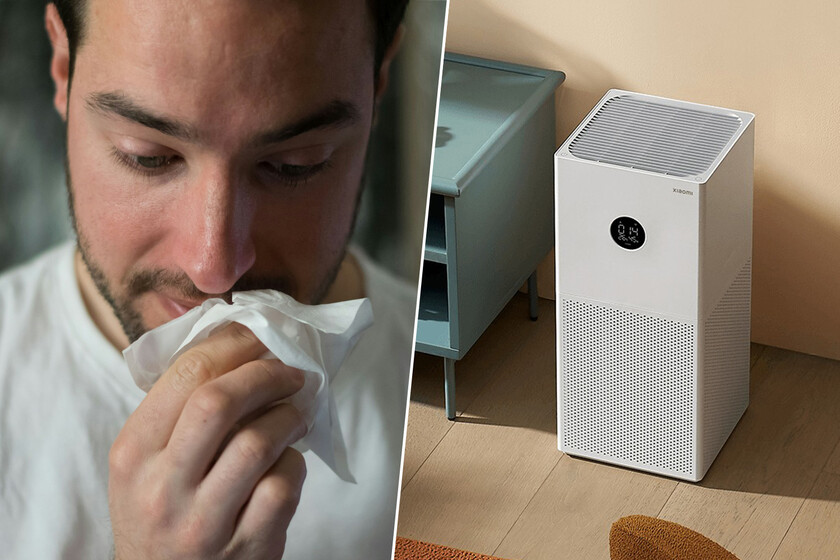
Spring brings a lot to the surface, and some of it isn’t pleasant at all. Pollen allergies and many other particles attack us and can spoil our day. Of everything you can buy to fight them at home, the most effective and useful option is undeniably an air purifier. But how do you choose the most suitable one for your home?
That’s the question I’ve been asking myself the past few days, since every purifier I’ve seen comes with a tangle of numbers and data that, paradoxically, can confuse more than help us pick. After doing a bit of digging, I’ve come to the conclusion that, if I have to focus on one thing, it would be the CADR. Here’s why.
Purificador de aire Philips Serie 2200, HEPA NanoProtect + Filtro de carbón activo, CADR 400m³/h para 104m², Personas alérgicas, Ultra silencioso, Filtro inteligente y duradero (AC2210/10)
Hoy en Amazon — 219,99 €
Contents (8)
- What CADR is and why it matters so much
- Running CADR too low is always a bad idea
- The good and the bad of both options, face to face
- Recommended models
- Low CADR: Xiaomi Smart Air Purifier 4 Lite
- Mid CADR: Philips Series 2200
- High CADR: Bosch Air 6000i
- Want to see more models?
What CADR is and why it matters so much
When you walk into a store like Amazon and search for a random air purifier (such as this Philips, for example), you’ll be overwhelmed with a lot of information right away. Perhaps the first thing that catches your eye is that it can remove 99.97% of the particles in the air, a very high figure. So what’s the catch? That claim appears in most purifiers, and it isn’t the most important metric. That’s where CADR comes in.
The CADR (Clean Air Delivery Rate or Tasa de Entrega de Aire Limpio in Spanish) is a unit of measurement that tells us, in short, how much filtered air a purifier can deliver. A purifier with the best possible filter is nice to have, but what good is it if it can’t move air and push it through the filter quickly enough? If it can’t, pollen or dust particles will settle on furniture and won’t be filtered.
The CADR has a numeric value calculated from two aspects: how many particles the filter can trap and how much air the purifier can move through that filter. No matter how good the filter is, it’s equally important that the purifier can move air through it, because otherwise it won’t trap dust or pollen effectively and they’ll keep floating around your room. Bad news for your allergies.
Small note to keep in mind. CADR isn’t a single value, it’s three values. This happens because purifiers have a CADR for pollen, but also for dust and for smoke. This is important, because what we should focus on is the pollen CADR. The other two are more secondary.
Running CADR too low is always a bad idea
If we go back to the Philips purifier mentioned above, it theoretically seems ideal for rooms up to 44 square meters in under 17 minutes. Now, however, you have to read the fine print on the device’s Amazon page:
It is a theoretical one-time cleaning time calculated by dividing its CADR of 170 cubic meters per hour by the room size of 48 square meters (assuming the room has 20 square meters of surface and 2.4 meters in height).
Why do I say this? Because even if a purifier’s description states it’s optimal for a room of a certain size, these are references drawn under specific conditions that may not match your home. The best approach is to take the purifier’s CADR and run a simple calculation to avoid mistakes.
This calculation unfolds in three steps, which I summarize right below:
- First, we need to know the cubic meters of the room where you’ll use the purifier. It’s calculated by multiplying length, width, and height.
- Second, we need to know how many times you want the purifier to refresh the air. AHAM (the Association of Home Appliance Manufacturers) recommends between 5 and 8 per hour.
- Third, we multiply the room’s volume in cubic meters by the air changes per hour we want.
Quick example. If you have a room with a volume of 25 cubic meters (measured as 4 meters long, 2.5 meters wide, and 2.5 meters tall) and you want the purifier to renew the air 5 times per hour, you should look for a purifier with a CADR of at least 125 cubic meters per hour. Careful here, because many purifiers present this information in cubic feet per minute (CFM), which is the original AHAM standard.
Now, does it make sense to buy a purifier with a CADR much higher than what you need? If you go for this scenario, you’ll end up with a device that filters your room’s air faster and possibly without the motor running at full capacity all the time (which means lower power consumption and less noise). The catch here is that a higher CADR usually does mean paying more for the purifier. The choice is up to each user, but with one clear guideline: never undershoot the CADR.
The good and the bad of both options, face to face
In a nutshell:
👉 Choose a CADR low or mid (up to 400 cubic meters per hour): you want an affordable purifier for a small room and you don’t plan on moving it around much.
👉 Choose a high CADR (above 400 m³/h): you want faster purification or you plan to place it in a larger room.
Recommended models
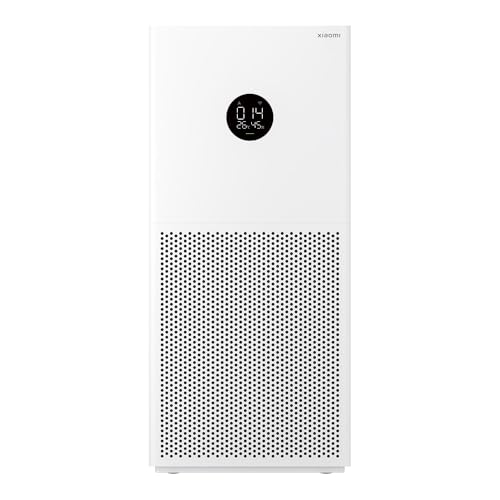
CADR low: Xiaomi Smart Air Purifier 4 Lite
This Xiaomi air purifier is one of the bestsellers, and with its current price on AliExpress, it’s a great value for small rooms (its CADR is 120 cubic meters per hour). Its maximum noise level is 61 dB, its filters last between 6 and 12 months before needing replacement (the mobile app will notify you when it’s time) and it measures 24 x 24 x 52 centimeters.
Xiaomi Smart Air Purifier 4 Lite, Filtro HEPA 3-en-1 H13, elimina 99,97% partículas, 43㎡, PM2.5, modo auto, control vocal Alexa y Google, silencioso dormitorio oficina
PVP en PcComponentes — 144,99 €
Xiaomi — 149,99 €
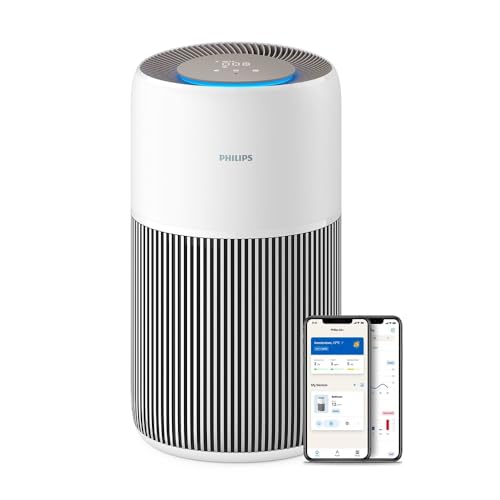
CADR mid: Philips Series 2200
We move up to 400 cubic meters per hour of CADR with this Philips Series 2200 purifier. This device also calculates the filter’s life, but in this case it lasts up to 36 months. It has an automatic mode that keeps track of air quality and adjusts its performance accordingly, which is handy so you don’t have to do anything. It also features a silent mode of 13 dB, perfect for night use.
Purificador de aire Philips Serie 2200, HEPA NanoProtect + Filtro de carbón activo, CADR 400m³/h para 104m², Personas alérgicas, Ultra silencioso, Filtro inteligente y duradero (AC2210/10)
Hoy en Amazon — 219,99 €
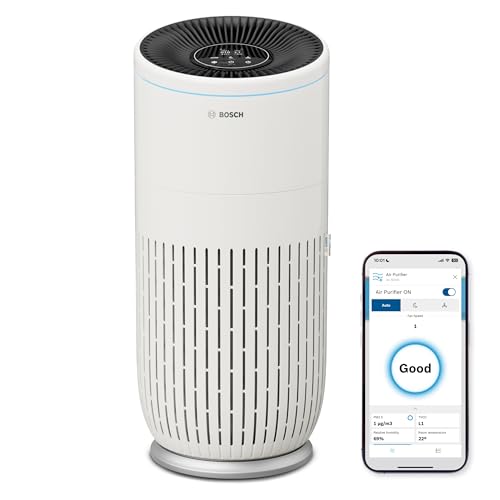
CADR high: Bosch Air 6000i
If you’re after a purifier for large spaces, this Bosch model offers a CADR of 600 cubic meters per hour. It’s the most expensive of the trio, but with it you’ll have a device you can place in any room and enjoy clean air, no matter how large the room is. It features a night mode that barely reaches 25 dB and also includes an automatic mode that you can configure or schedule from your phone.
Bosch Purificador de Aire Inteligente Air 6000i – Cubre 125 m², Filtra Eficazmente más del 99% de los Contaminantes, Filtro de Aire, Modo Auto/Resposo (< 25 dB(A)) – CADR: 600 m³/h – Funciona con App
PVP en Amazon — 399,98 €
Want to see more models?
If none of these three convinces you, you can check out our air purifier buying guide with different models organized by price range.
Some of the links in this article are affiliate links and may generate a commission for Xataka. If not available, offers may vary.
Image | sang lee, Lasse Jensen, Xiaomi, Bosch, Philips
On Xataka | What is the best laptop for work in 2026? Tips and recommendations
On Xataka | Don’t fall into wiring everything to your home’s 5GHz network: when it’s much better to use 2.4GHz