

With June arriving, the official start of summer is just around the corner. Even though thermometers have already begun to show peak temperatures, before a heatwave sweeps in, one of the questions most households ask is: “How do I cool the house without turning the place into construction chaos?”
Mellerware – Ventilador de techo retráctil Brizy plegable de 40 W
Today on Amazon — €99.99
Installing a traditional split-type air conditioner is not just expensive, it also requires HOA approvals, a certified installer and, worst of all, drilling into the facade. Fortunately, climatization technology has advanced enough so that today there are powerful, efficient, and above all, plug-and-play alternatives. If you rent your home or simply want a solution for today, in this post we’ll present the different options currently available on the market to fight heat waves without having to do any kind of construction.
Contents (19)
- Portable air conditioner (the classic penguin)
- Advantages of penguins:
- Disadvantages:
- Window air conditioner
- Advantages of window AC units:
- Main drawbacks:
- Evaporative coolers: only work well in dry climates
- Advantages of evaporative coolers:
- Disadvantages:
- Ceiling fans (with DC motor)
- Main advantages:
- Disadvantages:
- All the pros and cons of both models side by side
- Understanding how much each one costs
- Recommended models
- Portable air conditioner De’Longhi Pingüino PAC EM90K SILENT
- Window air conditioner MEDION P502 (MD 37735)
- Evaporative cooler MIDEA
- Ceiling fan Mellerware Brizy Bright
Portable air conditioner (the classic penguin)
The portable air conditioner, or “penguin,” is the most direct option. Unlike a fan, this unit includes a compressor and refrigerant and truly cools the room.
- How it works: it draws the warm air from the room, cools it, and expels the excess heat to the outside through a flexible hose that you must vent out the window.
- What to bear in mind: it’s essential to use a window sealing kit (most models include one). Without it, the warm outside air will re-enter through the hose opening, wrecking the unit’s efficiency.
- Ideal for: rooms between 15 and 25 square meters. They’re perfect for bedrooms or home offices.
Advantages of penguins:
Real, immediate cooling: because they have a compressor and refrigerant (usually R290, one of the most common refrigerants with the lowest climate impact compared to older ones), they lower the room temperature effectively, something no fan can do.
Mobility: they come with wheels, which lets you use them in the office by day and move them to the bedroom at night.
Great for renters: since no fixed installation is required, you can take it with you during a move without losing the investment.
Disadvantages:
- Noise: their Achilles’ heel. Unlike a split, here the compressor (the motor) is inside the room. They rarely drop below 50-65 dB, which can disturb sleep or concentration.
- Vacuum effect: by expelling hot air through the hose to the outside, they create negative pressure in the room. This forces hot air to enter from other parts of the house through door gaps, causing the unit to work hard continuously.
Window air conditioner
Although in Spain they are not as common as in other countries (the United States, for example), today you can see window units that don’t require permanent, fixed installation.
The innovation lies in the new “U-shaped” models that let you fit the window in the middle of the unit. This leaves the compressor (the noisy part) outside and the control panel inside, allowing you to open and close the window almost as usual.
Advantages of window air conditioners:
- Less noise: the U-shaped design keeps the compressor outside and interior noise is noticeably reduced.
- You don’t lose the window: unlike traditional two-piece portables that block the window all summer, this design lets you open and close the window relatively normally.
- Greater efficiency: it doesn’t suffer from the negative-pressure issue that one-tube portables do, so it cools faster while using less energy.
Main drawbacks:
- Window compatibility: not suitable for every home. It’s almost exclusively designed for sash or sliding windows. If you have tilt-and-turn or casement windows, installation can be unworkable.
- Heavy installation: though no construction is required, the unit is heavy and requires securing a safety bracket on the windowsill to prevent it from tipping outward. It’s not as plug-and-play as the wheeled portable.
Evaporative coolers: only work well in dry climates
First thing to know: they are not air conditioners. That said, in proper conditions evaporative coolers are magical and consume roughly as much as a light bulb.
- The secret: they use a water filter (which you can chill with ice). A fan blows air through that damp filter, cooling it via evaporation.
- Where they work best?: they’re only effective in environments with low humidity (e.g., Madrid or the interior of the peninsula). In humid areas, like the coast, their performance drops a lot and can worsen the muggy feeling.
Advantages of evaporative coolers:
- Ridiculously low energy consumption: they have no compressor, only a fan and a small water pump. They consume between 50 and 100 W (roughly the same as a traditional light bulb), so the electricity bill barely notices.
- No hoses or exterior outlets: you don’t need to have a window nearby or fight with plastic tubes. You can put it wherever you want.
- Better humidification of the air: it doesn’t dry out the air like conventional AC, avoiding throat irritation or dry eyes.
Disadvantages:
- Geographic effectiveness is limited: they only work when ambient humidity is low (dry interior climates like Zaragoza, Madrid or Seville).
- Muggy effect: if used on the coast (Valencia, Barcelona or Galicia, among others), where humidity is already high, the unit won’t cool and will saturate the air with moisture, drastically increasing the feeling of heaviness and sweating.
- Constant maintenance: you must keep refilling the water and ice reservoir manually every few hours for real refreshment.
Ceiling fans (DC motor)
They don’t actually lower the air temperature, but the thermal sensation can drop by a few degrees thanks to the evaporative effect of sweat on our skin. New DC motors are ultra-quiet and consume up to 70% less than older models.
Many current ceiling fans install simply by replacing the ceiling light fixture, with no complex wiring needed. In addition, many models include a reverse function that in winter helps push warm air accumulating at the ceiling downward, saving on heating costs.
Main advantages:
- Hidden energy consumption: modern DC motor models consume only 4–5 W at their lowest speeds. You can keep them running 24/7 for just a few cents a month.
- Quiet operation: DC motors are almost inaudible. The only sound is the soft whisper of the blades slicing the air, making it ideal for sleep.
- Healthy and stylish: they’re usually unobtrusive at low speeds overnight, and today they double as designer lighting that outfits the living room or bedroom.
Disadvantages:
- They don’t actually lower the temperature: as noted, a fan cools by moving air, not by lowering the air temperature. It speeds up sweat evaporation, reducing perceived temperature by several degrees, but if the room is 35 °C, the air remains 35 °C.
- Ceiling mounting: although it doesn’t require major construction, it does require drilling into the ceiling, securing the bracket properly to avoid falls, and a basic electrical connection.
All the good and the bad that both models have in common
Understanding how much each one costs
One of the key factors that determine which climate control device you choose is the impact on your electricity bill. To help you grasp their consumption, we’ll run the figures using the same scenario for everyone and taking into account three variables:
- Usage time: eight hours a day (for example, during remote work or sleeping).
- Period: 30 days (one summer month).
- Estimated electricity price: €0.15 / kWh (taxes included).
In this table we summarise the cost of using each of these devices in that scenario, so you understand how your summer electricity bill will behave depending on what you choose.
Looking at these figures, if your goal is to stay comfortable while spending only a few euros, combining a ceiling fan with a DC motor with moderate use of the air conditioner is the master formula to survive summer without breaking the bank.
Recommended models
Portable air conditioner De’Longhi Pinguino PAC EM90K SILENT
This premium portable air conditioner offers 9,800 BTU (around 2,450 kcal/h) and is ideal for cooling spaces up to 25–30 m². It stands out especially for its Silent technology, which dramatically reduces compressor noise to help with night-time rest, and for its triple function that cools, dehumidifies and ventilates. It also includes a convenient remote control, a 24-hour timer and uses eco-friendly R290 refrigerant, ensuring efficient and sustainable performance without driving up the electricity bill.
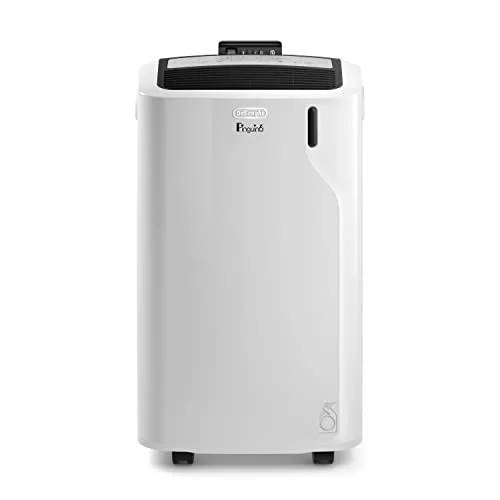
De’Longhi Pinguino PAC EM90K SILENT Aire Acondicionado Portátil 9.800 BTU/h
Today on Amazon — €0.00
PcComponentes — €649.00
Leroy Merlin — €717.65
And if you don’t want to spend as much on this type of device, Cecotec offers compelling entry-level models such as the ForceClima 9450 Style, which includes a heat pump (so you can also use it in winter). And if you want a portable air conditioner that resembles a split but without an external unit, there’s the Olimpia Splendid Unico Evo, which installs with two small openings and features a heat pump and WiFi connectivity.
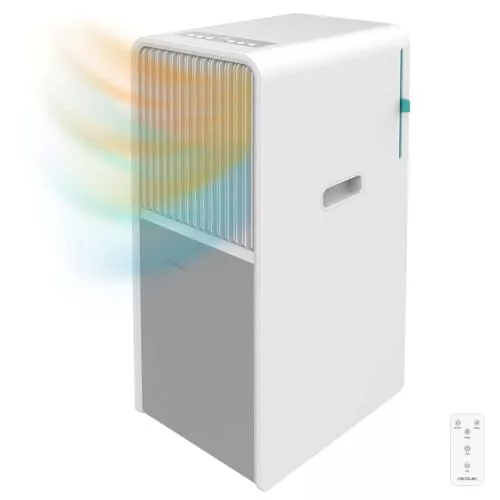
Cecotec Aire Acondicionado Portátil con Mando y Bomba de Calor ForceClima 9450 Style Heating
Today on Amazon — €234.90
PcComponentes — €234.90
Leroy Merlin — €302.37
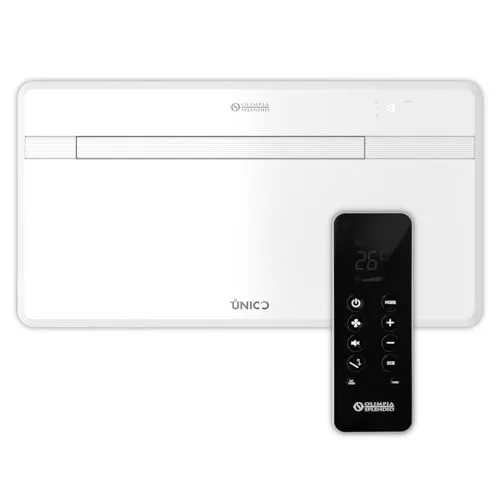
Olimpia Splendid Unico Evo 20 HP Pvan
Today on Amazon — €1,801.04
Aire acondicionado de ventana MEDION P502 (MD 37735)
MEDION P502 (MD 37735) is an innovative portable split air conditioner with WiFi, ideal for caravans, camper vans or bedrooms up to 12 m². Its big advantage is that it splits the unit into two connected sections by a flat hose, enabling you to hang the compressor outside the window to keep noise outside. Being a true split, it offers superior energy efficiency to traditional penguins, cooling quietly and without the need for costly home renovations.
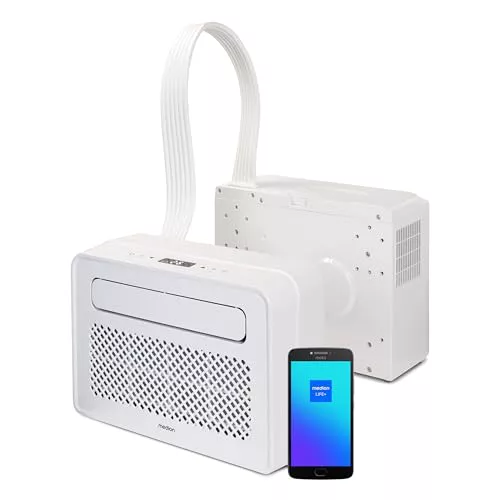
MEDION Smart Split Aire Acondicionado Caravana P502
Today on Amazon — €499.95
Climatizador evaporativo MIDEA
This evaporative cooler is the best-selling one on Amazon right now and is a versatile 3-in-1 device that works as a fan, humidifier and air cooler, making it ideal for naturally and affordably refreshing mid-sized rooms. It stands out for its large seven-liter tank, which offers long runtime, and for incorporating Sensi Cool technology to efficiently adjust the temperature. It also features six speeds, a broad automatic 85° oscillation, a 12-hour timer and a remote control.
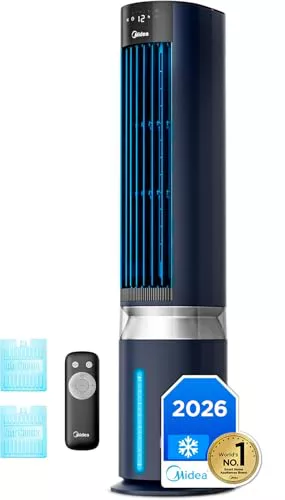
MIDEA Climatizador Evaporativo Portátil 3 en 1 Capacidad 7L y Mando a Distancia
Today on Amazon — €132.53
Ceiling fan Mellerware Brizy Bright
The Mellerware Brizy Bright stands out for its three elegant retractable blades, a 132 cm diameter ideal for rooms up to 20 m², and an ultra-quiet operation with six speeds that lets you sleep without bothersome hums. In addition to its very low energy consumption, it includes a LED ceiling light in three color temperatures, a timer for up to 8 hours, and the handy reverse function to optimize heating in winter.
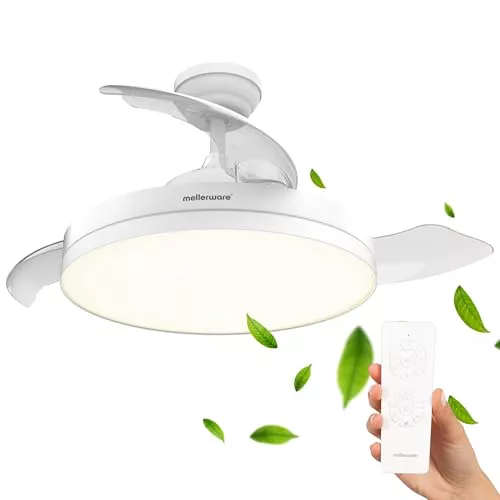
Mellerware – Ventilador de techo retráctil Brizy plegable de 40 W
Today on Amazon — €99.99
On Xataka Smart Home | The best thermal blinds: which to buy? Tips and recommendations
On Xataka Smart Home | The best portable air conditioners: Which to buy? Tips and recommendations