
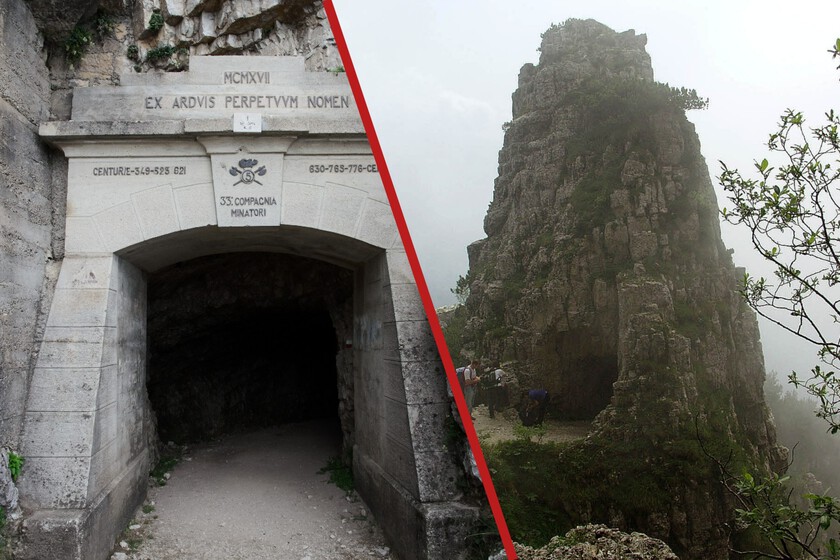
To bury the A-5, the Madrid City Council has been at it for more than a year and a half. And there are civil projects underway that have suffered years of delays: like this sea highway, the most expensive ever conceived, which is expected to be completed after 15 years of work. Yet at the turn of the 20th century, amid a harsh winter and at an altitude of over 2,000 meters, a group of miners from the Italian army built in just nine months the road known as the Road of the 52 Tunnels (Strada delle 52 Gallerie).
Excavated in the Italian Alps, it was deemed “a feat of giants, unmatched on the entire European front.” And beyond the harsh weather and the inhospitable terrain, it was conceived in the midst of World War I. Today it is one of the most spectacular and busy mountain routes in Europe.
More than 6 km of Alpine road with tunnels carved into the rock
It is not paved, nor do cars pass along it: the Road of the 52 Tunnels is a mountain pass, though it was designed with enough width for two mules to pass. It is also known as Strada della Prima Armata (Road of the First Army) and sits on the southern slope of Monte Pasubio, which rises to 2,239 m, being the highest peak of the Little Dolomites in the Veneto region.
The route of this Strada delle 52 Gallerie extends to a total of 6.5 km (6,555 meters), traversing a rugged landscape of sheer walls, chasms and rocky towers. Of these, 2.3 km are tunnels carved into the rock of the mountain. Its minimum width is 2.20 m, designed precisely to allow passage of up to two pack animals. Another notable feature is that it climbs a very steep grade (roughly 700 m of elevation), with an average incline of 12% and at its steepest reaching 22%.
What stands out most about this engineering work from more than a century ago, conceived in record time, is its tunnel gallery. Some tunnels are only a few meters long, while others extend hundreds of meters beneath the mountain. Each tunnel was assigned a number: the longest and most famous is No.19, 320 m in length with a spiral route formed by four tight turns inside a rocky tower. It connects to No.20, one of the most challenging due to its corkscrew shape.
The rest of the Road of the 52 Tunnels is made up of narrow ledges on the mountain, offering splendid views of the Pasubio valleys. In some tunnels, huge windows were opened in the walls, through which one can glimpse the Italian Alpine paradise.
In just nine months by a little over 600 men
This military route was born out of necessity during World War I: the Italian army needed an alternative to the Strada degli Scarubbi (Scarubbi Road), exposed to Austro-Hungarian artillery. A hidden road, safe from enemy fire, to deliver the essential supplies to the trenches. And so this rock-cut pass on the vast Monte Pasubio came to life.
Designed by Lieutenant Engineer Giuseppe Zappa, its construction was initially entrusted to the 33rd Company of Miners of the Italian Army, with about twenty men digging under the direction of Captain Leopoldo Motti. A month later, it became clear that the epic task required many more hands: around 600 soldiers from other regiments joined the effort. Along the way, Motti was replaced by a new overseer: Captain Corrado Picone.
The works began in March 1917 and by December of that same year the Road of the 52 Tunnels was finished: an absolute record time given the hardships. First, that winter was one of the harshest of the 20th century, with subzero temperatures, heavy snow and frequent avalanches. And second, due to the tools available at the time: they relied on rudimentary drilling equipment, picks and explosives that allowed a passage through living rock by April. It is worth noting that they had little cartography, given how inaccessible and unknown the terrain was.
The road with more than 50 names. It is not surprising that once it was realized, Captain Picone described it as the result of “tenacious will, exemplary work, sacrifice and selflessness, and a moving spirit of emulation among the mining engineers’ teams assigned to its construction.”
The same Picone drafted the document that assigned a number to each of the fifty tunnels. But it also named them, paying tribute to those who made this mountain pass a reality: from Captain Zappa to Picone himself, and various lieutenants. It also honored officers and fallen soldiers, Italian monarchs, or references to places on the Alpine front.
A mountain route between tunnels and historical memory
Today this Road of the 52 Tunnels is part of the Italian Alpine Club (CAI) network, drawing hikers from across Europe. The trail blends nature with history: travelers can enjoy the spectacular views and the alpine flora and fauna, while imagining how troops crossed the pass carrying supplies. Indeed, in some tunnels you can see restored carts or military equipment on display.
The full route lasts about five and a half hours. CAI rates it as medium-difficult: some sections, such as tunnels 19 and 20, are particularly challenging. It is advised to carry flashlights, as much of the underground passages are in complete darkness. For several years now it has been restricted to pedestrians only, with bicycles banned after a number of tourists died when they fell from the trail.
Be that as it may, more than a century later, the Strada delle 52 Gallerie remains one of the greatest feats of military engineering ever conceived in a mountain: a road born of war that today endures as one of the most spectacular hiking routes on the planet.
En Motorpasión | We know more about the surface of Mars than about our own ocean: the mystery of the “road” found 3,000 metres below the sea