
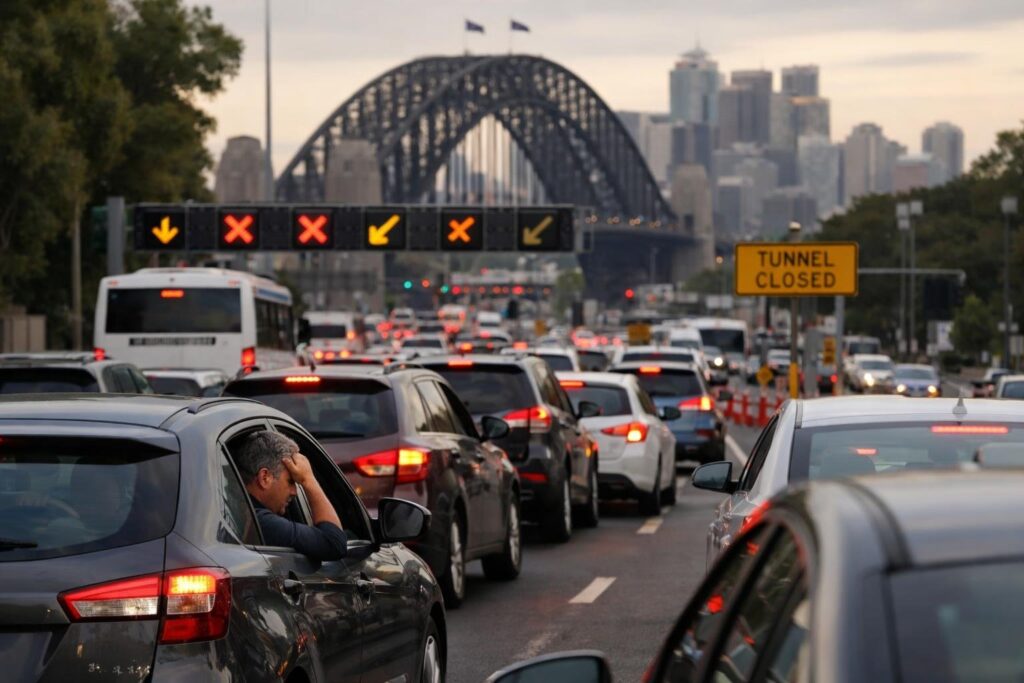
Evening turned to gridlock as a sudden shutdown of Sydney’s Harbour Tunnel stranded thousands during peak hour. What should have been a quick cross-harbour hop became a slow-motion crawl, with horns, hazard lights, and a chorus of frustration echoing across the city. Ferries filled, phones died, and patience ran thin while motorists watched the fuel gauge and the clock in equal measure.
Chaos on a crucial artery
The Harbour Tunnel is a pressure-valve for the city’s north–south flow, and last night that valve seized. Lanes were closed without warning, sending drivers onto the Bridge, local streets, and any side road that looked promising. Ramps backed up past Milsons Point, while queues spilled into the CBD with little space to breathe. “Every route felt jammed,” said one rider, “like the city had run out of exits.”
Voices from the long ride home
“I left work with a bag of groceries and a plan,” said Priya, “but by 7 pm the lettuce was soup.” Another motorist, Tom, described the wait as “an exercise in stillness, broken only by small rolls forward and bigger sighs.” A bus passenger reported the driver making three detours and still getting stuck near the toll booths. “A trip that’s usually twenty minutes stretched close to two hours,” said Amira, “and I only made it because I bailed for a ferry.” Rideshare prices rose with the tension, and pedestrians paced the footpaths, eyeing packed buses that sometimes skipped stops.
What officials said—and didn’t say
Transport for NSW urged patience, citing safety checks and incident management inside the tunnel. Crews worked behind barriers as traffic controllers waved red wands, their reflective vests catching the glare of brake lights. “Our priority is safety,” a spokesperson said, promising a step-by-step restore of capacity once engineers cleared hazards. Details on root cause remained thin, with authorities noting “operational issues” and recommending alternative routes.
Ripple effects that hit every corner
When the tunnel stalls, everything else gets heavier. The Harbour Bridge choked, Western Harbour routes groaned, and inner-city intersections became puzzles with no neat solution. Delivery windows slipped, childcare pickups turned into last-minute pleas, and small businesses watched late customers evaporate into the evening.
- Packed ferries became the unexpected saviors, while cycle lanes saw a spike in cautious, rain-jacketed riders.
- Neighborhood streets turned into rolling carparks, with residents guiding reverse maneuvers and defensive patience.
- Apps rerouted endlessly, but most options fed back into the same bottlenecks.
- Social feeds filled with heat-map screenshots, exasperated selfies, and crowdsourcing for passable shortcuts.
The price of fragility
Sydney’s transport web is robust until a single thread snaps—and then the whole fabric sags. Redundancy sounds boring, yet it’s the difference between a manageable delay and a citywide stall. Experts have long urged staggered work hours, more dynamic lane management, and smarter real-time signage to bleed pressure from the choke points. Last night’s tedium was a loud, slow reminder that resilience is designed, not wished into being.
Commuters adapt, but not without cost
People improvised with ferries, phone chargers, and group texts offering spare seats to coworkers inching along the Quay. Some turned the wait into catch-up calls, some into silent meditation, and some into a stern promise to leave earlier next time. “I’d have biked if I trusted the late-night ride home,” said Leo, “but the return trip is a gamble.” Flexibility helps, but it shouldn’t be a permanent tax on people’s time and energy.
What needs to change now
Short-term fixes are obvious: clearer alerts, faster incident diagnosis, and better triage for priority buses when tunnels go dark. Medium-term, the city needs more cross-harbour capacity, smarter ramp metering, and signal plans that can pivot in minutes, not hours. Longer-term, it’s about knitting ferries, bikes, buses, and trains into a truly elastic system that shrugs off shocks instead of absorbing them like a bruise.
A night to remember—and to learn from
The evening’s standstill will fade, but the underlying lesson should not: one incident can undercut an entire metropolis when options are too narrow. Commuters did what commuters do—waited, worried, and found workarounds with weary grace. The city can match that resilience with upgraded infrastructure, sharper playbooks, and the humility to anticipate the next inevitable snag. Because when the tunnel shuts, time is what the city spends, and last night it paid in full.