
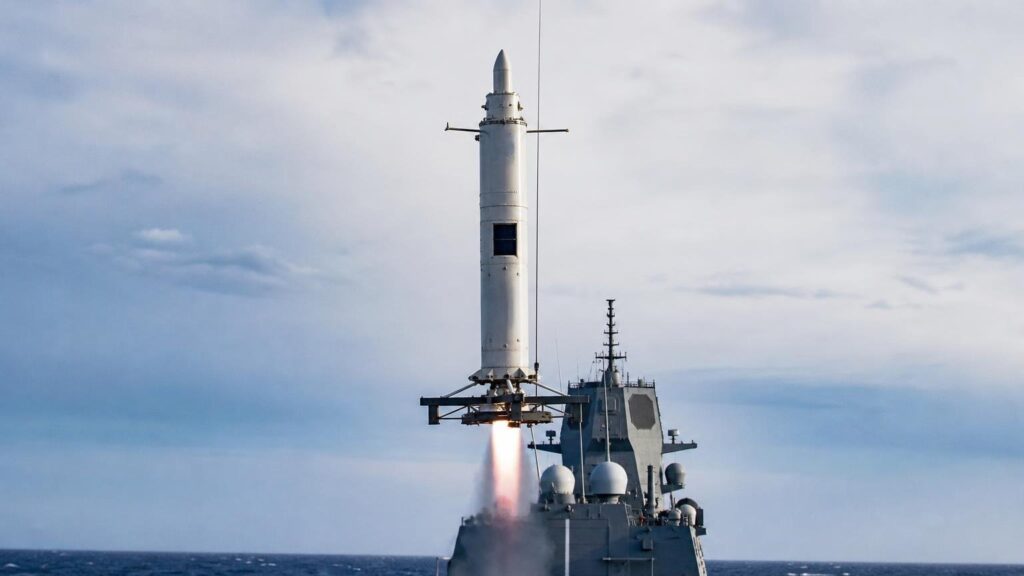
It’s not sleek, it’s not cinematic, and it doesn’t make headlines. Yet this quiet Australian invention has reshaped how navies survive the most dangerous seconds at sea. Engineers call it Nulka—a hovering rocket that tricks incoming missiles, pulling them away from billion‑dollar warships and toward empty ocean.
“It buys you time—seconds that matter,” as one veteran operator says. In modern naval combat, time is life, and this compact device keeps ships and crews afloat by making the enemy look the wrong way.
What it is and why it matters
Nulka is an off‑board, active decoy: a small rocket that launches from a canister, rises up, then hovers near the ship—far enough to be useful, close enough to be controllable. Instead of hiding, it projects a bigger, more enticing target than the ship itself, seducing radar‑guided missiles to chase the phantom.
Soft‑kill systems used to mean passive chaff and hope. Nulka adds intent. It shapes the battle, not by destroying a weapon, but by redirecting its attention. That shift turns a lethal threat into a manageable problem, sharpening the odds for every other defense on board.
How it works
At launch, a solid‑fuel motor pushes the decoy into a precise position. Thrust‑vector controls keep it steady, letting the unit hover in the wind like a robotic hummingbird. Once parked, its electronic payload goes to work: a digital RF repeater that makes a missile seeker see what it expects—a big, moving ship, bristling with reflections and motion.
Crucially, it doesn’t just shout loudly; it shouts believably. The signal mimics ship‑like radar signatures, including Doppler, glint, and other subtle cues that modern seekers use to filter fakes. The decoy lures the weapon into a clean, predictable arc—away from the hull, into a safe void. “Make the threat look at the wrong thing, not at nothing,” as one engineer likes to say.
Born in Australia, adopted by the world
The idea was nurtured inside Australia’s defense science community, refined by local industry, and proven at sea with allied fleets. It is now standard on more than a hundred Western warships, riding aboard destroyers, frigates, and auxiliaries that cannot afford to lose a single engagement.
For Australia, this is not just a homegrown success—it’s a template for smart, asymmetric engineering. Instead of out‑muscling the threat, Nulka out‑thinks it, exporting a very Australian kind of ingenuity: simple to use, hard to defeat, built for real‑world weather and real‑world crews.
The ugly-beautiful math of survival
Modern naval self‑defense is a stack: detect, deceive, jam, shoot, and then shoot again. Layered effects turn narrow margins into livable probabilities. Here, Nulka plays the most elegant role—cutting the attacker’s kill probability before the first missile is fired in anger.
- Off‑board positioning means the “ship” the missile sees is safely elsewhere.
- Vertical hover creates a stable, high‑fidelity target that seekers can’t easily ignore.
- Autonomous control reduces crew load, speeding reactions when seconds are scarce.
- Compact launchers fit small and large hulls, multiplying fleet‑wide coverage.
In practice, a seduced missile is a spent missile. Every weapon tricked is a weapon not intercepted, saving finite magazines for what must be killed. That economy of force is priceless on long patrols far from friendly ports.
Why you haven’t heard of it
Decoys don’t stage photos. Their victories are invisible: no dramatic intercepts, no camera‑friendly explosions. When they work, nothing happens, and the ship sails on. Add in classification and operational security, and you get a world‑class capability that lives mostly in footnotes and whispers.
There’s also the drama bias. People celebrate fast jets and supersonic missiles—things that roar, streak, and flash. Nulka hums, hovers, and lies with authority. It’s warfare’s quiet logic, not its bright spectacle.
What comes next
Threats are evolving: seekers blend radar with infrared, fuse data with off‑board cues, and fly cunning, sea‑skimming profiles. The response is evolution in kind—more agile waveforms, multi‑spectral decoys, coordinated swarms that create moving mazes in the sky.
Expect Nulka’s descendants to talk to each other, to ships, and to drones, sculpting false fleets in real time. Expect smarter timing, richer signatures, and tighter ties between soft‑kill and hard‑kill layers. The aim stays simple: bend the enemy’s perception until it breaks, and keep crews safe to fight again tomorrow.
Some weapons win by erasing targets. This one wins by erasing certainty. In that small, decisive gap—between what a missile thinks it sees and what is actually there—sits an Australian invention that has saved more ships than we will ever read about.