
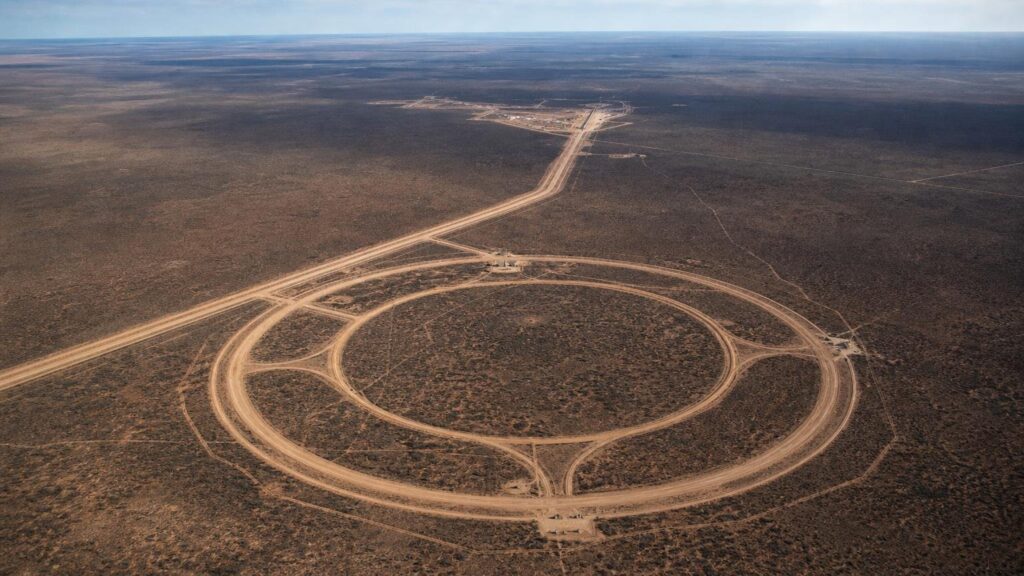
Under the cobalt skies of South Australia, an expanse of red earth stretches so far that horizons look unfinished. This is a place shaped by silence and speed, where machines are pushed until they reveal their limits. The sheer scale rewires perspective: roads run straight for hours, instrumentation dots ancient plains, and the air itself feels like a proving ground for ideas that travel faster than sound.
Where the map turns blank
Set in the state’s remote interior, the range spans more than 120,000 square kilometers—an area so vast it’s often compared to an entire country. From shimmering salt lakes to low mulga scrub, the terrain is rugged, empty, and unforgiving, a natural buffer that keeps experiments far from towns. “Think of a laboratory without walls,” goes a common refrain, “and a sky that belongs to the brief moment between launch and impact.”
A place built for flight and fire
Created in the late 1940s for postwar aerospace trials, the complex evolved with every new era of technology. Rockets howled from desert pads, cameras tracked bright arcs across the night, and telemetry vans filled with blinking consoles rode the edge of experiments. The history here is thick with firsts: early guided missiles, pioneering space launches, and cooperative projects that stitched together alliances through data and risk.
How you test the future without neighbors
Big ranges are about more than raw distance. They buy time, safety, and the freedom to fail quietly. When a hypersonic test lights up the sky, you want instruments positioned far downrange, multiple viewing angles, and an airspace envelope that keeps curiosity out. “Range time is the currency of innovation,” engineers like to say, “and range silence is its security.”
What actually happens out there
On any given campaign, you might see radar dishes turning toward a receding speck, high-speed cameras humming on sun-baked tripods, and mobile command rooms packed with specialists. The menu changes with the decade, but it typically includes:
– Long-range missile trials, guidance experiments, and precision tracking across huge corridors
– Hypersonic research flights that stress materials and test new aerodynamics
– Uncrewed aircraft and swarming systems practicing autonomy at true scale
– Electronic warfare scenarios and complex signal environments
– Telemetry, optics, and data-fusion drills that turn desert into living graphs
Coexistence with people, culture, and country
Despite the sense of emptiness, this landscape is deeply inhabited—by memory, law, and living custodianship. Traditional Owners hold connections that predate rockets by countless generations, and cultural heritage is part of every modern plan. Pastoral leases and mining interests operate through schedules and permits, carefully deconflicted so a single test does not derail an entire region. It’s a choreography of access, respect, and risk.
Hardware meets horizon
Size matters because flight is a story told in distance. Guidance algorithms need long baselines to prove they can think; re-entry vehicles demand kilometers for heat to build and decay; communications links reveal their flaws only when the desert starts to curve the Earth away. You learn different lessons in 20 seconds of flight than you do in two minutes, and this place trades in the latter.
Town, runway, and the human layer
There’s an entire human infrastructure behind the dust: a township that swells with campaign crews, a runway that catches visitors and departing prototypes, and logistics teams who can conjure a field instrument range out of crates, cables, and maps. “Every test is a small expedition,” a range hand might say, “with the desert as your most honest critic.”
The view from the highway
Most of the time, the range is a study in deliberate absence—closed gates, red signs, and the quiet authority of restricted airspace. Yet fragments are visible if you know where to look: a glint of rail-mounted cameras, a far-off boom rolling like distant thunder, or a contrail that appears from nowhere and dives into heat-hazed distance. The public face is modest; the real work travels by radio and rumor.
Why it still leads the world
Other nations run formidable ranges, but few combine isolation, instrumentation, clear skies, stable governance, and cooperative access at this scale. The desert offers rare predictability: weather that behaves, horizons that don’t intrude, and room to test what can’t be tested elsewhere. The result is a magnet for programs that need space, secrecy, and an appetite for precision.
Out here, technology grows up in the company of silence. A launch window opens, a countdown drops, and the desert does what it always does—it tells the truth at full volume, then keeps the secret it was asked to hold.