
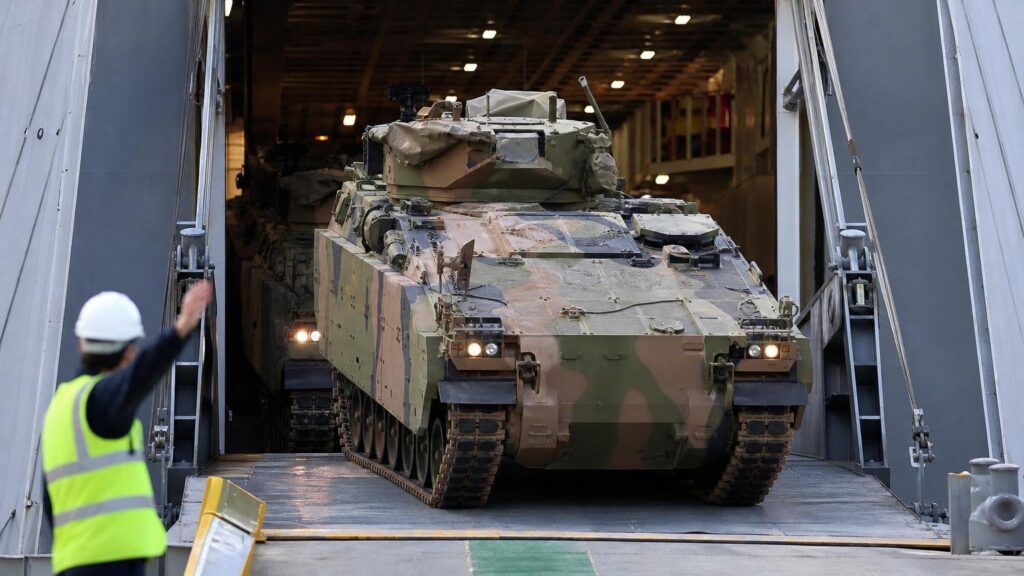
Steel plates glow under floodlights. Sparks fall like confetti. In a corner of suburban Queensland, new armoured hulls rumble onto a test track, their engines deep and assured. Then they’re bound for an unexpected destination: back to the European nation that first conceived the design. It’s a loop that says as much about global supply chains as it does about strategy.
From blueprint to outback assembly line
The vehicles trace their lineage to a European consortium, but their current heartbeat comes from a high-tech factory near Brisbane. At Rheinmetall’s MILVEHCOE complex in Redbank, Australian fabricators, machinists, and software specialists assemble a modern workhorse of mechanised forces. The design’s DNA is distinctly German, yet the accents on the shop floor are unmistakably Australian.
“It’s a full-circle moment,” said a senior engineer at the facility. “We’re taking a foreign blueprint, adding local know-how, and shipping a battle-proven product back to the original architects.”
Why Europe is buying Australian-made armor
Several forces are pulling in the same direction. European armies are replenishing stocks after years of underinvestment and recent transfers to support allies. Timelines for new production in Europe are stretched by labour, component, and capacity bottlenecks. Australia, meanwhile, has a warm industrial line, trained workers, and access to critical inputs.
Germany’s calculus is practical and political. Buying from a trusted partner keeps fleets standardised, sustains NATO-ready interoperability, and shortens the time from contract to deployment. “Speed is an advantage we cannot ignore,” a European defence official noted. “Queensland’s line lets us field capability in months, not years.”
The factory that learned to sprint
The Queensland plant grew up on tight schedules and demanding specifications. It blended military-grade machining with automotive discipline. Over time, it built a supply base for steel, electronics, optics, and mobility systems. That muscle memory now matters.
The vehicles leaving Redbank are no mere clones. They reflect iterative upgrades, local quality quirks, and software tweaks aligned to contemporary threats. Ballistic protection, blast management, and digital backbone are all tuned for combined-arms operations. “It’s not just rolling steel,” a production manager said. “It’s a connected platform.”
Sovereign capability with allied dividends
For Australia, the export back to the designer nation is a paradox with benefits. It strengthens sovereign manufacturing at scale while anchoring the continent in a premium tier of defence production. It also spreads risk across hemispheres. If supply tightens in Europe, Australia can surge; if the Indo-Pacific heats up, Europe can return the favour.
- Faster fielding for allies while preserving a diversified, resilient production base on two continents
The supply chain, unglamorous and decisive
Behind each vehicle is a choreography of logistics. Armour-grade steel, specialized bearings, powerpacks, and encrypted electronics must arrive on time and to spec. Heat-treating, welding, and non-destructive testing demand both craft and discipline. Delays in a single sensor can idle an entire line.
To hedge, the program has qualified dual suppliers where possible, built buffer stocks of slow-moving parts, and standardized interfaces so modules can cross-load between national fleets. Freight moves by sea for cost efficiency, then by rail to inland hubs. Critical items fly when timelines tighten, a costly but sometimes necessary choice.
What the soldiers will notice
Crews will find familiar ergonomics, with refinements in seating, sightlines, and climate control for hot-weather ops. Maintainers will notice improved access to high-failure components, clearer digital fault codes, and better training aids. Commanders gain a networked node that can ingest battlefield data and share it with adjacent units.
“It’s the difference between a vehicle that fights and a vehicle that coordinates,” said a former cavalry officer who has trained on earlier variants. “That coordination is where modern advantage lives.”
Politics never far from the weld line
Big orders make headlines, but they rest on politics. Legislators want local jobs; generals want speed; treasuries want value. The Queensland-to-Europe pipeline gives each a piece of what they need. It’s not perfect—currency swings, export controls, and election cycles can all interfere—but the structure has proven durable.
Critics ask whether outsourcing to a distant continent is prudent. Supporters counter that dispersed capacity is itself a form of deterrence. “If your factory footprint is global, your risks are distributed,” an industry analyst said. “That’s hard to target.”
Beyond this batch
What begins as a single order rarely ends there. Tooling investments push unit costs down as volumes rise. Engineers line up new variants: reconnaissance, ambulance, command post, heavy weapon carrier, and more. Software spirals bring cybersecurity and sensor upgrades. The vehicles evolve as the battlefield changes.
In the long view, this loop—from European design to Australian manufacture and back to European service—is a case study in 21st-century defence economics. Capability now travels along the fastest reliable path, not the shortest geographical one. And in a world where time is often the scarcest resource, that path may be the most strategic asset of all.